
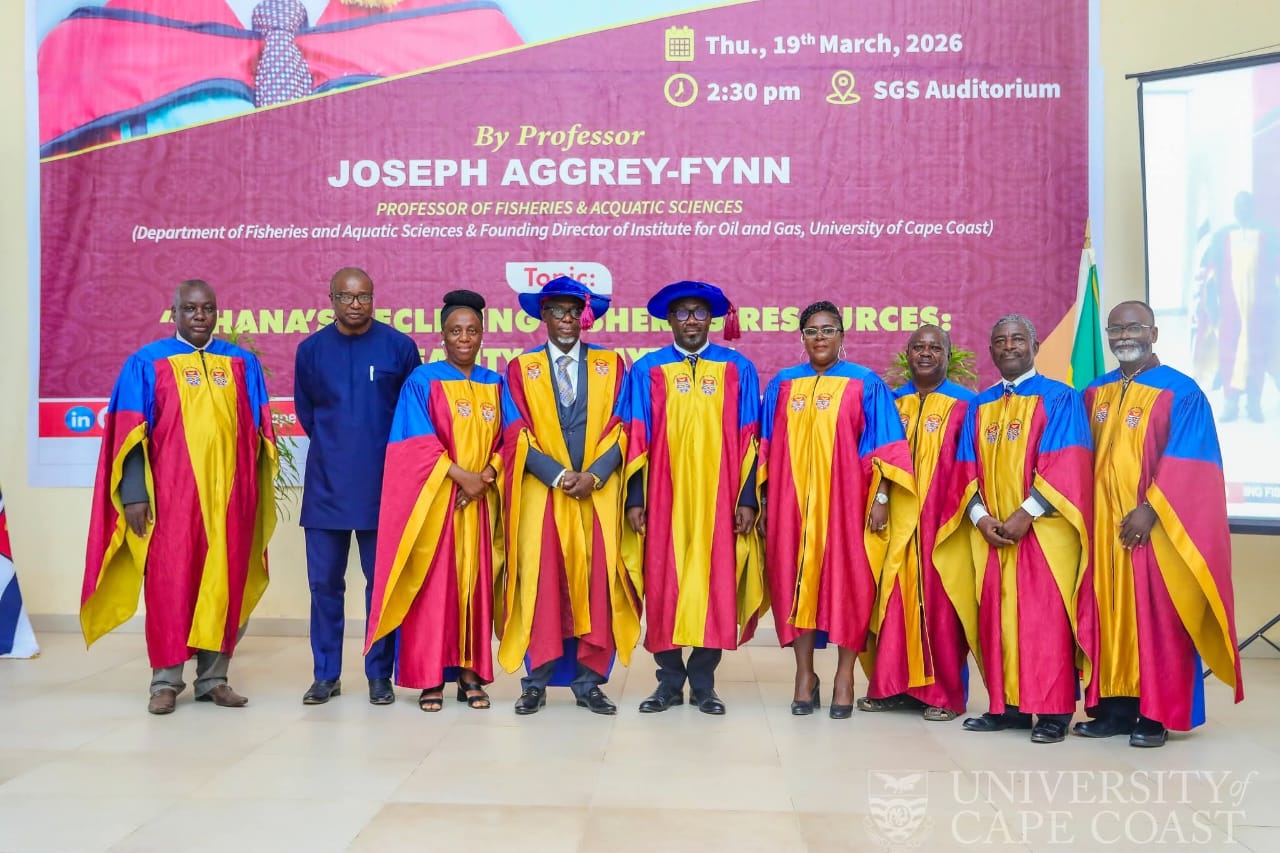
Professor Joseph Aggrey-Fynn, a Professor of Fisheries and Aquatic Sciences with the University of Cape Coast (UCC), has urged swift action to establish a marine spatial plan to regulate activities in Ghana’s marine waters.
 According to him, the unrestrained activities of all kinds in the country’s waters were disturbing the marine ecosystem and expediting the depletion of the fish stock and other marine resources.
A comprehensive spatial plan, he contended, would set clear boundaries and restrictions to strengthen Ghana’s fisheries management and help to replenish the stock.
Prof Aggrey-Fynn, who is also the Founding Director of UCC’s Institute for Oil and Gas, made the proposal when he delivered his inaugural lecture on the topic: “Ghana’s declining fisheries resources: Reality or myth.”
With a tonne of data, he laid bare the contributions of the fisheries sector to the Ghanaian economy and food security, indicating that it contributed 1.2 per cent to the national GDP and provided 60 per cent of the annual protein needs.
However, he observed a meteoric depletion of the fish stock, particularly the Sardinella species, due to overexploitation, poor fisheries management and some climatic conditions.
In that regard, he said authorities must take urgent action to salvage the situation.
He commended ongoing efforts to establish the first Marine Protected Area (MPA) at Cape Three Point in the Western Region but proposed the spatial plan as an extra layer of protection.
“We should go further to establish a Marine Spatial Plan.
“If you go to Norway today, some places in their marine spaces are not open for even oil exploration,” he noted.
Prof Aggrey-Fynn’s lecture highlighted the rifeness of Illegal, Unreported and Unregulated (IUU) fishing practices such as the use of explosives and noxious chemicals, light fishing and catching of juvenile fishes, which were also contributing to the dwindling fish stock.
He attributed the situation to authorities’ inability to police the waters fully, urging the government and the Fisheries Commission to work to reduce it to the barest minimum.
The professor called for a strict enforcement of the new Fisheries and Aquaculture Act 2025 (Act 1146) to ensure sustainable fishing practices and conserve the fish stock.
He observed that the new act had adequate regulations and measures to protect and preserve the sector, urging stricter punishment against illegal fishing.
“The Fisheries Commission needs everybody’s support because they don’t have enough officers on the field,” he said.
“You should let the practitioners know that if they continue to do fishing in the old ways that they do fishing, then they should know that their livelihood will one day come to a halt,” he added.
In furtherance of the fisheries management efforts, Prof Aggrey-Fynn entreated government to expedite action to operationalise the national fisheries college.
By Prince Acquah, GNA