

Deadline: 15th July 2026
The African Research Universities Alliance (ARUA), with support from the Mastercard Foundation and the Carnegie Corporation of New York, is launching this Early-Career Research Fellowship program. The initiative will fund up to forty-two (42) early-career researchers to conduct globally competitive research at the host and affiliated institutions of ARUA’s thirteen (13) Centres of Excellence (CoEs) and the twenty-two (22) Clusters of Research Excellence (CoREs).


• The fellowship period for option 1 runs from March to August 2026. The deadline for application for option 1 is 22nd January 2026.
• The fellowship period for option 2 is September 2026 to February 2027. The deadline for application for option 2 is 15th July 2026.
At least 70% of the fellowships are reserved for female candidates, and applicants must be no older than 35 years at the time of application.
The program aims to enhance the capacity of early-career researchers at African universities by providing them with time away from teaching duties at their home institutions to collaborate 4 with highly experienced and distinguished researchers at ARUA CoEs or the Africa-Europe CoREs. Each CoE or CoRE is expected to host research fellows from countries other than its own.
ARUA has established thirteen (13) Centres of Excellence (CoEs) across various disciplines to support its vision. These CoEs reflect the current priority areas of ARUA, and they are expected to significantly enhance research and graduate training.
Currently, the 13 CoEs are organized into two broad categories as shown below:
Natural Sciences
1. Water
2. Energy
3. Non-Communicable Diseases
4. Materials, Energy and Nanotechnology
5. Climate and Development
6. Sustainable Food Systems
Humanities
7. Post-Conflict Societies
8. Good Governance
9. Inequality Research (ACEIR)
10. Migration and Mobility
11. Notions of Identity in Africa
12. Unemployment and Skills Development
13. Urbanization and Habitable Cities
Together with The Guild of European Research Universities, ARUA has also established twenty-two (22) to align with priority themes of the AU-EU Innovation Agenda.
Currently, the 22 CoREs are organized into four thematic areas as shown below:
Public Health CoREs
- Advanced Infectious Diseases Research and Training
- Multimorbidity
- Food Environment Actions for the Promotion of Health
- Non-Communicable Diseases and Multimorbidity
- Genomics for Health in Africa
- Preparedness and Response to Pandemics and Shocks
- Health, Gender, and Sexualities
- Translational Research in Infection, Immunity, and Inflammation
- Migration and Health
Green Transition CoREs
- Nature-Based Solutions for Climate Change Adaptation and Mitigation
- Sustainable Water and Land Resource Management for Human Well-Being
- Renewable Energy
- Water Resources Management for a Sustainable and Just Future
- Integrative Conservation Biology Research and Training
Innovation & Technology CoREs
- Artificial Intelligence, Data Science, and Theoretical and Computational Thinking
- Sustainable Food Systems
- Creative Economies: Cultures, Innovation and Sustainability
- Engineering for the Future
- Mathematics
Roles and Responsibilities of the Research Fellow
The key roles and responsibilities of the research fellow are as follows:
- Work with other researchers to undertake various relevant studies at the CoE or CoRE under the guidance of an assigned mentor.
- Write and publish a minimum of one (1) academic paper[1] (a jointly authored paper where the fellow is the first/lead author can be acceptable) in a high-impact journal (at least, indexed in Scopus or Web of Science), with an accompanying policy brief or blog post on the appropriate platforms of the respective host institution.
- Deliver at least two (2) presentations and participate in technical workshops with fellow researchers and other stakeholders.
- Assist in creating and bolstering new partnerships between the respective CoE or CoRE and other relevant bodies.
- Assist in disseminating research findings of the CoE or CoRE.
[1] In limited cases, a full draft manuscript may be accepted. But this must be subjected to some review process by the ARUA Centre of Excellence and considered publishable.
Contract and Remuneration
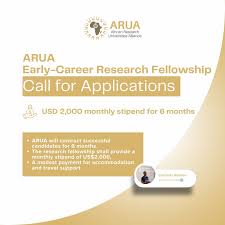
Successful candidates will be contracted by ARUA for 6 months. The research fellowship shall provide a monthly stipend of US$2,000, a modest payment for accommodation, and travel support (return ticket to host institution). Please note that there are no relocation expenses. Additional financial support is available for eligible women who may require adjustment assistance (e.g., for childcare). The host CoE will provide the research fellow with office space.
Selection Criteria
- Applicants must be African nationals who have a PhD in a discipline/sub-discipline related to the thematic area of the Centre of Excellence or Cluster of Research Excellence.
- Applicants must be within 5 years of completing their PhD
- Applicants should be young faculty (or research) members at an ARUA university. Eligible candidates from non-ARUA Universities can apply.
- Female postdoctoral fellows will be considered in limited cases.
- The applicant should not be more than 35 years old at the time of applying.
- Applicants should have a highly competitive track record relevant to the opportunity and be willing to develop a strong international standing and research reputation.
- Applicants must be available to spend 6 months away from their home university and be able to return to their home institution.
- Applicant must be working on an ongoing project related to the CoE or CoRE and have readily available data to accomplish the main roles and responsibilities (see section 3)
- Eligible women are strongly encouraged to apply. At least 70% of the fellowships will be awarded to female candidates.
For more information and application.


