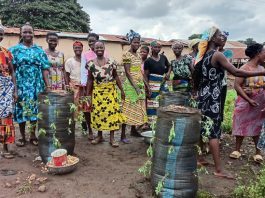
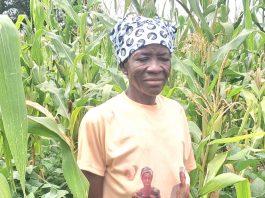
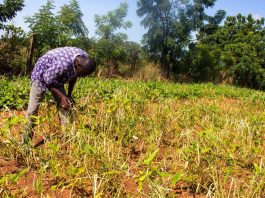
Access to agricultural information is a prerequisite for farmers adopting sustainable farming practices. Changes in rainfall patterns especially in the North West of Ghana underscore the need to observe Good Agricultural Practices (GAPs) to obtain the desired yield. This is evident among farmers benefiting from the European Union Ghana Agriculture Programme (EU GAP).

In the last three years, EUGAP through the Market Oriented Agriculture Programme (MOAP-NW) and the Resilience Against Climate Change (REACH) project adopted radio to disseminate timely agricultural information to farmers. It rolled out a comprehensive programme using the radio to reach out to farmers with information aimed at achieving positive change, particularly in adopting Good Agricultural Practices (GAPs) including Conservation Agricultural (CA) practices.
Farmers are educated on GAPs activities such as row planting, compost preparation, farming as a business, the appropriate time for planting, and post-harvest management. These practices, however, are evident on Mary Nyeyela’s farm.
The 33-year-old mother of two has a 4-acre soybean farm in the Daffiama-Bussie-Issa district of the Upper West Region. Mary recounted how the programme influenced her decision to venture into soybean production for the first time since she started farming. “I decided for the first time to plant soybeans by practising what was been taught. I planted on time, used certified seeds, planted in rows, and used shea shells as compost to provide nutrients for the soil,’ she said.
She further explained how the inconsistency in rainfall patterns and the climatic condition experienced in 2022, didn’t affect the output she expected. “Although the rains didn’t come as expected my consistency in practising the agricultural information received through the radio allowed me to harvest 4 maxi bags of soybean and still counting.”, she added.
Just like Mary, Adam Abdul Latif a farmer in the North Gonja district narrates how his soybean produce had increased from 2 to 5 bags per acre upon adhering to the practices he heard on the radio.
The 30-year-old farmer shared how post-harvest losses affect his income since the value of the crop depreciates and consumers are unwilling to buy at the original prices.
“I used to harvest my crops late and dry them on the bare floor, but I now know the appropriate time for harvesting the crops and drying them on a tarpaulin to prevent losses”, he said. Radio hosts and Agriculture Extension Agents (AEAs) who serve as panelists for the programme revealed that, although the radio programme is targeted at farmers in operational communities, its benefit extends to other farmers as well and applauded the support of the projects to farmers.
EU-GAP comprises 3 pillars: Resilience Against Climate Change (REACH), Market Oriented Agriculture Programme in North-West Ghana (MOAP-NW), and Productive Investment Programmes (PIP) in the Northern Savannah Ecological Zone. The radio programme is run through the REACH and MOAP-NW components, which is co-funded by the European Union (EU) and implemented by Deutsche Gesellschaft für Internationale Zusammenarbeit (GIZ) GmbH in collaboration with the Ministry of Food and Agriculture (MoFA).
Credit: Gloria Boamah