

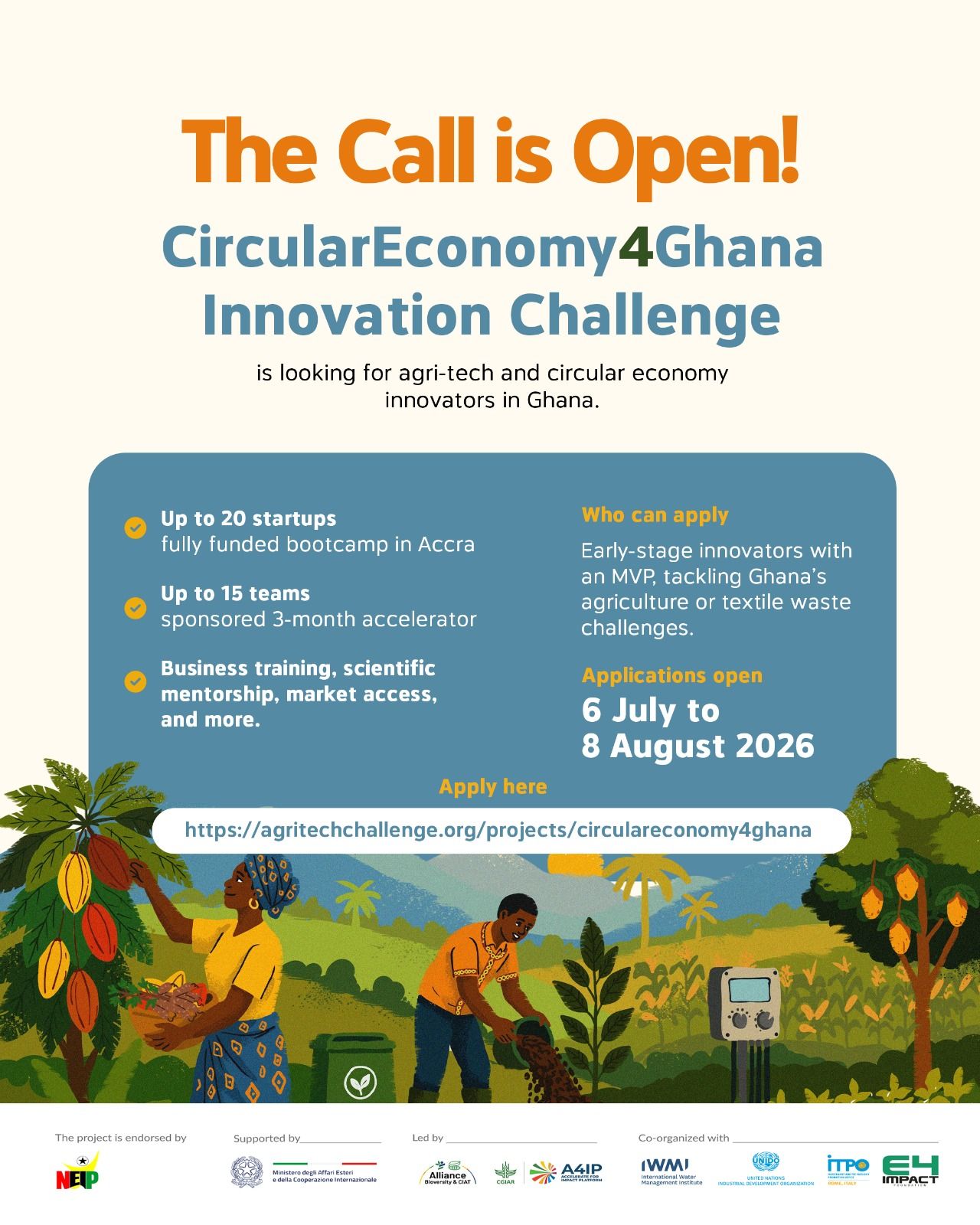
Deadline: 8Th August 2026 at 23:59 (UTC)
What if the future of Ghana’s food security could be shaped by circular economy?

They empower entrepreneurs to test, scale-up, and grow their early-stage innovations into market-ready solutions providing tailored business mentorship, market access, product validation, and pilot testing with end-users.
The CircularEconomy4Ghana Innovation Challenge is led by the Alliance of Bioversity International and CIAT through the Accelerate for Impact Platform (A4IP) and implemented in partnerships with the International Water Management Institute (IWMI), the United Nations Industrial Development Organization (UNIDO) / ITPO and with E4Impact, with support of the Ministry of Foreign Affairs of Italy.
Benefits
Join the CircularEconomy4Ghana Innovation Challenge and get the chance to refine, test, and scale your agri-tech solution in one of West Africa’s most dynamic ecosystems.
Through the program, you will receive hands-on tools and step-by-step support to build a solid go-to-market strategy, validate your technology, and access real market opportunities. You will benefit from:
- A deep understanding of Ghana’s agriculture.
- A fully funded, 4-day immersive bootcamp in Accra, Ghana.
- Strategic connects with agribusinesses and ecosystem partners.
- Expert guidance from CGIAR scientists and UNIDO experts.
- A 3-month sponsored accelerator program, structured around five pillars, combining entrepreneurial training, technical assistance, and more.
- Opportunities to meet investors and commercial partners.
Eligibility
- They are on the look-out for early-stage agri-tech innovations with a working Minimum Viable Product (MVP), ideally already tested with end-users.
- Teams should be actively fundraising at the pre-seed or seed stage.
- Solutions must address real market needs, respond to local agricultural challenges, align with at least one of the designated priority areas, and deliver tangible benefits to smallholder farmers and value chain actors.
- Innovative Financing and Financial Access for Circular Agri-Enterprises
- Digital Advisory and Knowledge-Sharing Systems for Circular Agriculture
- Waste Segregation, Collection, and Valorization Systems
- Nutrient Recovery and Circular Soil Fertility Solutions
- Traceability, Data, and Supply Chain Efficiency for Circular Value Chains:
- Inclusive Circular Business Models for Youth and Women
For more information and application.


I will be grateful to be part of this program
No comment