

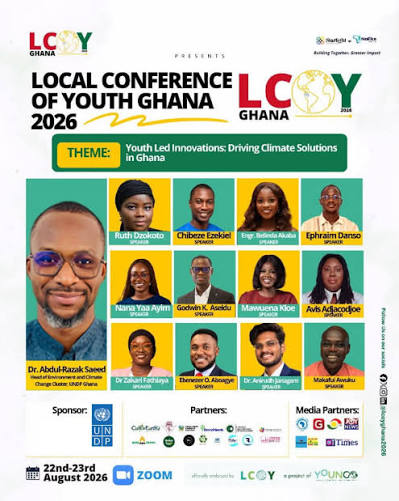
Ghanaian youth have unveiled practical, locally sourced climate solutions ranging from upcycled fashion to solar innovations, aimed at supporting efforts to addressing the country’s environmental challenges.


The online conference was organised by Starlight Foundation and Nalike Africa, in collaboration with the United Nations Development Programme (UNDP) Ghana, providing a platform for young people to share experiences, showcase innovations and contribute to Ghana’s climate action.
As part of its support to LCOY Ghana 2026, UNDP Ghana provided US$3,000 in awards to recognise outstanding youth-led climate innovations with the potential to contribute to climate action and sustainable development in the country.
Speaking at the conference, Dr Abdul-Razak Saeed, the Head of Environment and Climate Cluster at UNDP Ghana, reaffirmed the institution’s commitment to empowering young people as agents of change.
He noted that UNDP Ghana’s support formed part of its commitment to creating opportunities for young people to turn innovative ideas into everyday climate solutions, strengthen youth leadership and partnerships to advance Ghana’s climate ambitions.
Dr Saeed called for greater investment in youth-led climate solutions, stressing the need to create the right system for young people to innovate, lead and shape greener, more resilient equitable future.
“As we look ahead to COP31 and beyond, we must continue to create enabling environments for young people to innovate, lead, and influence climate action. We must invest in their ideas, support their initiatives, and empower them to become architects of a greener, more resilient, and more equitable future,” he said.
Madam Avis Adjacodjoe, Co-founder, Reusable Bags Ghana, cautioned that climate innovation premised on universal access to smartphones, stable internet and high-end markets would fail without the active inclusion, understanding and leadership of the youth.
She noted that grassroots communities, especially the youth must be treated as co-designers, not mere beneficiaries, of climate solutions, saying, “true climate resilience is built from the ground up a it relies on every single person.”
She encouraged everyday actions in schools, at various workplaces and in homes, ensuring that together, the country created inclusive solutions for the market woman, students, low-income earners, while local economies benefitted in the transition.
Hilda Dorcoo, an innovator in the waste and circular economy, identified discarded second-hand clothing left in markets and dump sites, and polythene wrappers littered after-market days as a major cause of environmental pollution in many Ghanaian communities.
She said the solution had been to upcycle the discarded fabrics, sheets and curtains into dresses, streetwear, tote bags and other usable items, while transforming polythene wrappers into accessories.
She identified the lack of market access and funding for machines as key challenges to scaling production, calling for seeking broader market opportunities for her upcycled creations and financial support to acquire machines and sustainably scale operations.
Comfort Senya, a Volta Region economy operator, said traders abandoned unsold clothes in markets and dumps, polluting gutters and waterways, while discarded polythene wrappers littered communities and worsened climate change.
Beyond creating products, she promotes circularity and youth engagement in sustainable fashion, but scaling is limited by lack of market access and funding for sewing machines, for which she seeks support.
By Francis Ntow, GNA


