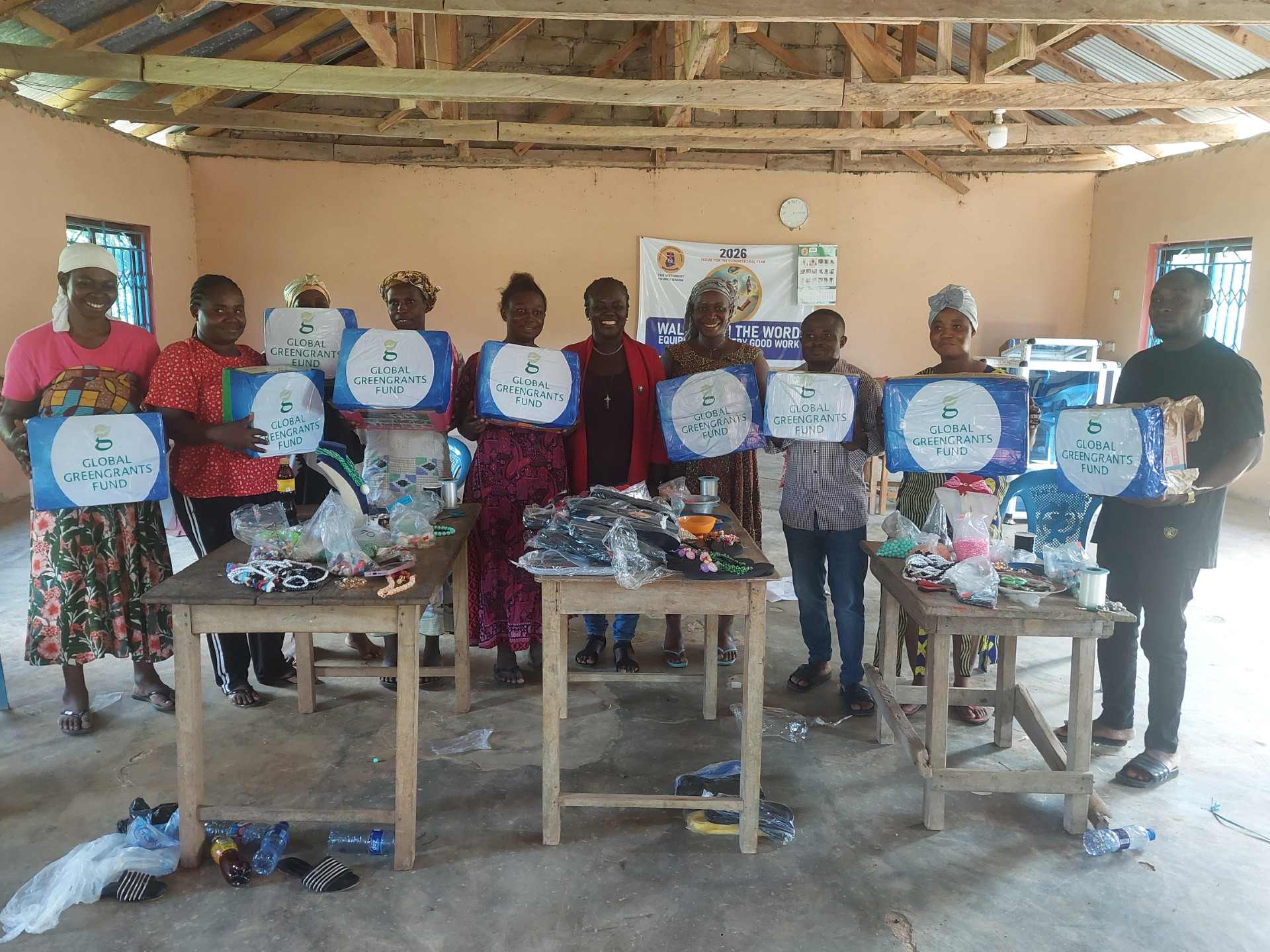
The Climate Change Awareness and Livelihood Empowerment Project, has presented start-up materials and financial support to nine farmers at Bogyampa in the Asutifi North District of the Ahafo Region.

Mr Peter Kwame, the Project Lead for the Climate Change Awareness and Livelihood Empowerment Project, explained that the intervention formed part of the project’s implementation, being supported by the Global Greengrant Fund (GGF).
He said the project sought to strengthen the resilience of farming households affected by declining agricultural productivity due to climate change impacts.
At a ceremony at Bogyampa, a farming community, Mr Kwame expressed concern about poor crop yields, saying that had worsened poverty levels of farming households in the area.
The support is therefore necessary to help diversify the sources of income of the beneficiaries and thereby reduce the impact of climate change on their livelihoods.
Mr Kwame explained that about a year ago, more than 200 farmers, mostly women and some few men in the community participated in an initial sensitisation and skills training programme, designed to equip the beneficiaries with alternative livelihood opportunities to cushion them against the adverse effects of climate change.
He said about 20 of them committed to pursuing vocational skills training, therefore the first batch of nine beneficiaries were being provided with start-up support, to establish their businesses.
Mr Kwame urged the beneficiaries to remain dedicated to their acquired trades, saying that their commitment would enable them to generate sustainable incomes.
He advised them to adopt the habit of savings and reinvest their earnings to expand their economic activities.
Mr Kwame encouraged them to avoid unnecessary spending that could drain their capital and profits, urging them to be financially disciplined, sustaining and expanding their business.
Miss Lucy Annor, the Resource Person, and Coordinator of the Tano Women Empowerment and Development Association, an NGO lauded the commitment to the beneficiaries.
“The first training lasted about a week because many of the participants were beginners and faced several challenges”, she stated.
She said, “The refresher course has shown that the beneficiaries understand the skills we taught them and are applying them effectively to improve their livelihoods,” adding that their progress had been impressive so far.
Ms Annor noted that the changes in rainfall patterns caused by climate change continued to affect agricultural production in the area, thereby making alternative sources of income increasingly important for farmers.
She advised beneficiaries to be serious, saying that employable skills training would provide reliable income sources for them.
Madam Mary Dade, 50-year-old beneficiary of the programme, who learnt bead weaving, expressed the hope that together with her daughter who also benefited, would establish a profitable business and improve their household incomes.
“As farmers, we sometimes experience poor harvests due to unfavourable weather conditions and during such periods, the skills we have acquired will help us earn an income and take care of our families,” another beneficiary, Emmanuel Kyei, a 36-year-old, indicated.
He advised young people to accept vocational skills training, which remained the pathway to economic security and self-reliance.
GNA
By Benjamin Akoto, GNA