The uptake of research evidence in the policy-making process has become the front burner of global discourse on approaches and strategies for development. It is therefore not surprising that international development agencies and other research funders, are placing increasing emphasis on the need to communicate research evidence to policy makers.

While efforts are being made to devise mechanisms for bridging research policy gap, it is important to note that policymaking is inherently a political process. Hence, many factors jostle with evidence to take center stage in policy formation, at an individual level and organizational level. For example, time constraints will affect the mechanisms available to mobilize.


Through TAAT Africa initiative, the Forum for Agricultural Research in Africa (FARA), procured audiovisual equipment with smartphones for strengthening capacity for technology, Knowledge Management for Agricultural Development Agenda delivery, and outreach in countries such as Ghana, Nigeria, Senegal, Rwanda, Mali, DR Congo, Malawi, Tanzania, and Zambia. This equipment comprises five Samsung Galaxy A5l smartphones, one hand-held projector (DCS 1000) with accessories (solar panel, Bluetooth speaker, keyboard, power bank, tripod stand and a projector screen).
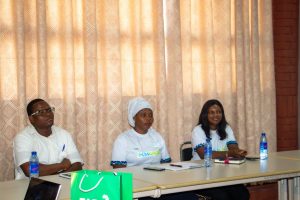
During the opening remarks for the ceremony, Dr. Seth Manteaw (Ph.D.) Director, of CSIR – INSTI Ghana noted, “There is no doubt that Internet penetration will continue to grow among farm communities. What is perhaps more important for EAS providers, funders, researchers and universities is to provide enterprise mechanisms using the Internet that maximize all technology use. Essentially, the Internet remains the cornerstone because it can connect the more educated participants in EAS throughout the world so that these participants do a better job working with farmers. Moreover, Benjamin Abugri , Lead specialist for Knowledge Management , Learning and Communication at FARA also stated that “The researchers and policymakers are coming up with a variety of solutions to help farmers to manage risks but the outreach and promotion of these solutions need a well-structured and effective medium. In this context, agricultural extension services play a very crucial role in bridging these gaps, through effective capacity building and awareness creation as highlighted in the #KM4AgD agenda. The KM4AgD agenda emphasizes the need to curb Fake News and ensure Quality information standards in empowering stakeholders to take informed action.


It is worth recognizing the Ghana KM4AgD’s team resilience in assisting farmers and other stakeholders, to manage these risks through KM4AgD Agenda tools box need closer collaboration with the Monitoring and Evaluation officers at MoFA, Mr. Patrick Twumasi mentioned. For example, extension services can effectively disseminate information about climate change, and promote technologies that can help farmers to mitigate various on-farm and off-farm risks. With the above background, KM4AgD Ghana champions call for institutionalizing and mainstreaming a learning framework to improve sectoral learning.
All the participants from these institutions are committed to KM4AgD agenda, in educating and training using this AUDIO-VISUAL EQUIPMENT for sustainable and relevant knowledge dissemination practices, in the field of duty. They recognize the support by the African Development Bank through the TAAT programme.
Please find the Accra Declaration on the KM4AgD Agenda for Africa published at this link: https://lnkd.in/gR9BjBuy
Story by : Paul Atsu, Zinabu Abdulai & Marilyn Yeboah (CAADP-XP4 KM4AgD Ghana Team)