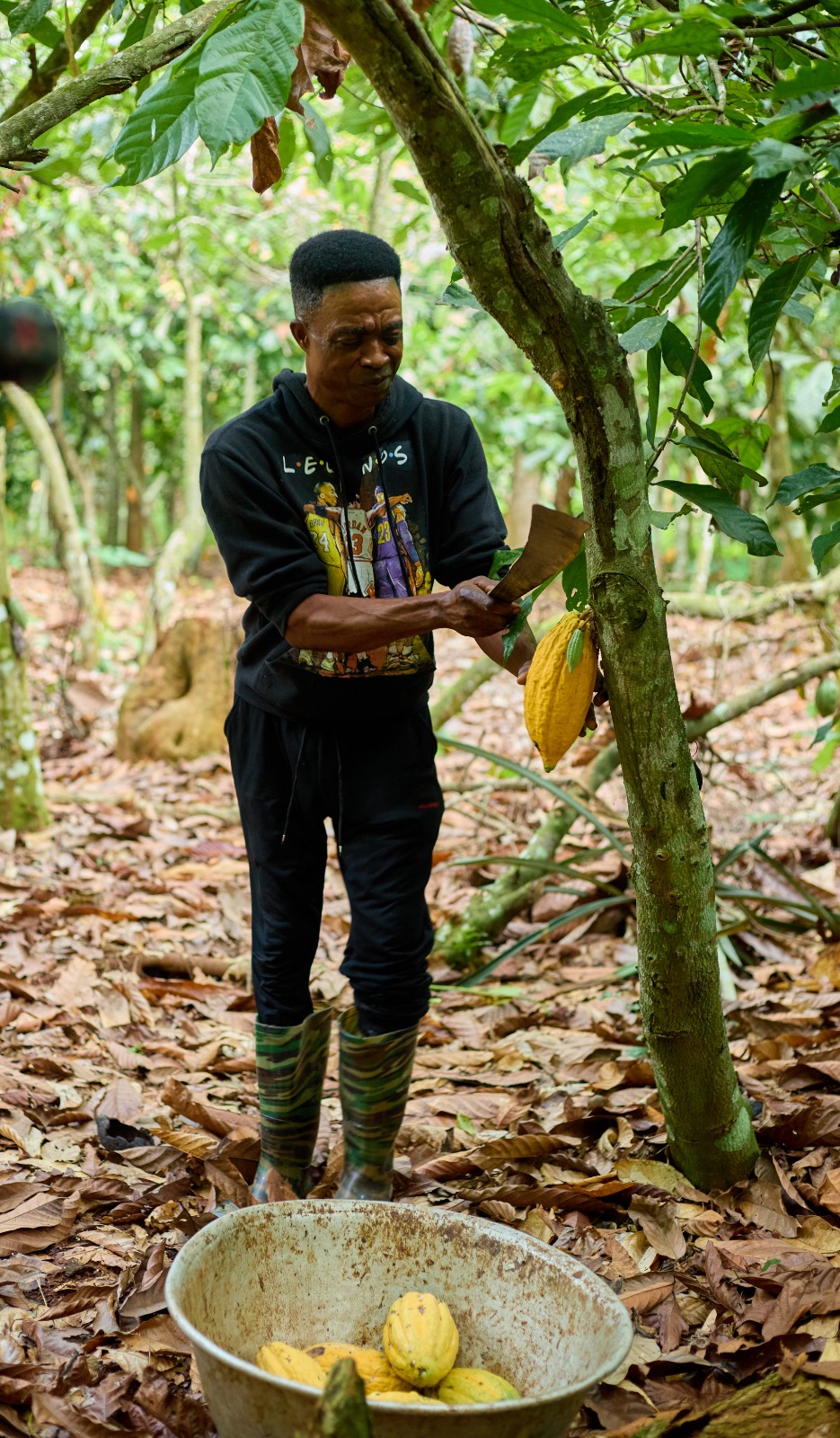
A day before I was elected Chair of the Fairtrade Africa Board, I sat in a room in Accra with cocoa farmers, leaders of cocoa cooperative, traders, policymakers and other stakeholders in the cocoa space, and listened to the same question asked in a dozen different ways: now that cocoa prices have fallen, who is going to make sure farmers don’t fall with them?

World cocoa prices have collapsed from more than $10,000 a tonne at their late-2024 peak to around $3,400 a tonne. What hasn’t collapsed is the cost of growing it, and the cost of living, thereby creating a major on farmer incomes.
For the farmers of Ghana and Côte d’Ivoire, who together grow roughly two-thirds of the world’s cocoa, that gap is not an abstract market calculation. It’s the difference between a season that affords a household a decent livelihood and one that doesn’t. Fairtrade International’s newly published 2026 Living Income Reference Prices provide a clear benchmark for what farmers need to earn to achieve a living income from cocoa farming: 1,758 CFA francs per kilo in Côte d’Ivoire, and 45.40 cedis per kilo in Ghana. These numbers are built from real farm-level data such as yield, land size and household needs.
But, it’s important to note that a reference price is only useful if and when someone pays it.
On one hand, The Fairtrade Minimum Price has long provided a safety net when market prices fall below the cost of sustainable production. On the other hand, the Fairtrade Premium provides additional resources that farmers and workers can invest in projects and priorities they identify themselves, and from October 2026, 40% of that Premium will go directly to farmers in cash. I have seen the difference these resources can make in producer communities; from investments in infrastructure and equipment to initiatives that strengthen livelihoods.
But these mechanisms cannot, on their own, close the living income gap.
That requires commercial commitment from buyers.
This is where the conversation needs to move beyond corporate social responsibility.
For cocoa businesses, farmer incomes are increasingly a question of supply-chain resilience. Cocoa farming faces an intergenerational challenge. When farming does not provide a viable livelihood, younger generations have fewer reasons to enter or remain in the sector. When farming does provide a viable livelihood, stable and sustainable supply chains can be secured. It moves investing from a moral obligation to a good business practice. Even more so, there is also a legal aspect.
Companies are facing growing regulatory expectations around human rights and environmental due diligence, traceability and supply-chain transparency. Regulations such as the European Union Deforestation Regulation are changing what businesses need to understand and demonstrate about the origins and conditions of the commodities they source.
This, therefore, creates an opportunity.
Businesses that build stronger, more transparent and more equitable relationships with cocoa producers can strengthen the resilience of their supply chains while contributing to better livelihoods for the people who grow the crop.
Fairtrade is one way of doing that. Our approach combines standards, certification, pricing mechanisms, the Fairtrade Premium and stronger producer voices. But the wider challenge is bigger than any one system or organization.
It is about how the cocoa industry chooses to share both the risks and the value within the supply chain. This is a conversation that must be held in the marketplace. Which is why, throughout September, Fairtrade Africa is leading this discussion through a business-to-business campaign. The message is simple: if we want a resilient cocoa sector, farmer livelihoods have to be part of the business equation.
As the newly elected Fairtrade Africa Board begins its term, this is one of the conversations we intend to advance, working closely with our producers, commercial partners, policy makers and other stakeholders globally, and across the value chain. The aim will be to strengthen the voice of producers and build a fairer, more sustainable trading system.
So here is my ask to cocoa buyers:
Look at the 2026 Living Income Reference Price for the origins you source from. Then ask your teams what it would take to move your sourcing closer to a price that enables farmers to earn a living income.
Cocoa prices will continue to rise and fall. That is the nature of commodity markets.
But whether farmers are able to earn enough to support their families, invest in their farms and plan for the future should not be left entirely to the next turn of the market.
The price of cocoa will change, but our commitment to the people who grow it should not.
Ms. Hend Kassab is the Board Chair of Fairtrade Africa.