
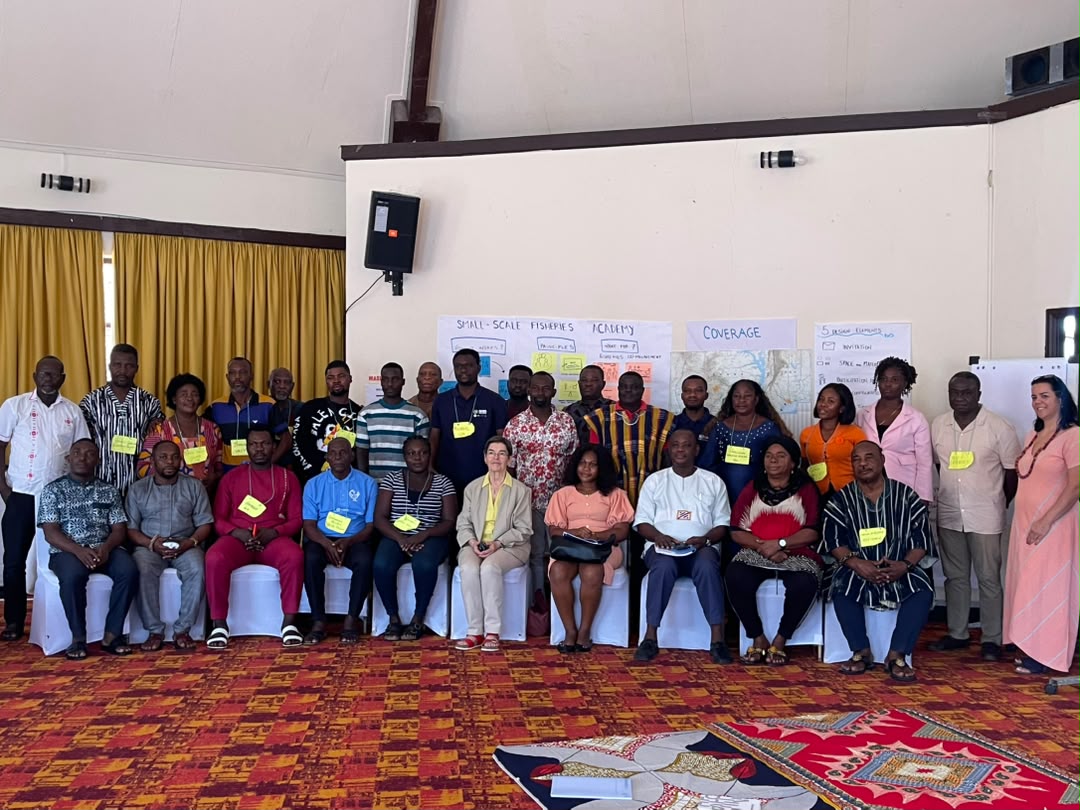
Thirty-five fisheries stakeholders including six females from Ghana’s four coastal regions ended the second session of the Small-Scale Fisheries Academy in Elmina on Thursday.
 The training was aimed at strengthening community leadership and laying the groundwork for more effective fisheries co-management.
Co-management in fisheries is a partnership arrangement in which government authorities and local resource users such as fishers, traders, and community groups share responsibility and decision-making power over the management of fishery resources.
Its essence lies in combining local knowledge and community participation with government’s legal and enforcement capacity to achieve sustainable, equitable, and effective fisheries governance.
The training was organised by Mundus Maris, a non-profit organisation and the Canoe and Fishing Gear Owners Association of Ghana (CaFGOAG), with support from Blue Ventures, in collaboration with the Fisheries Commission and the Ministry of Fisheries and Aquaculture.
The initiative supports the implementation of the Fisheries and Aquaculture Act, 2025 (Act 1146), which expands co-management arrangements and formally integrates Chief Fishermen, queen fishmongers and other community actors into fisheries governance.
It underscored the fact that strong community participation in fisheries management would promote responsible fishing practices, encourage compliance with regulations, resolve local conflicts and support the recovery and sustainability of fish stocks.
The beneficiaries were empowered on complementary communication activities, including FishTalks through short audio messages shared via WhatsApp and Community Information Centres to help make information on fisheries legislation and responsible practices more accessible to coastal communities.
Seeking to build on the maiden Academy held in Winneba in June 2026, the Elmina session deepened participants’ skills in community facilitation, dialogue, leadership and participatory planning.
The beneficiaries will equip local facilitators to bring together diverse groups within fishing communities including chief fishermen, canoe owners, women fish processors, traders, crew members and other fisheries professionals to discuss challenges, identify shared priorities and co-create solutions.
These dialogues are designed to create conditions for communities to organise, build trust among stakeholders, agree on common priorities and work towards establishing community-level fisheries co-management committees in line with Act 1146.
By creating structured spaces for local stakeholders to participate in decisions affecting their livelihoods and marine resources, the process seeks to strengthen community ownership and collaboration with fisheries authorities.
Over the next three months, the initiative plans to organise additional community meetings in 20 fishing communities through the Sankofa Fisheries Dialogues.
Speaking to the Ghana News Agency on the sidelines of the event, Dr Cornelia E. Nauem, President of Mundus Maris, applauded the Ministry of Fisheries and the Fisheries Commission for the bold reforms aimed at formalising Ghana’s artisanal fishing sector and improving data collection to quickly identify challenges and opportunities.
A key milestone, she cited was the extension of the industrial exclusion zone from six to 12 nautical miles, a move seen as critical to protecting inshore small pelagic stocks that sustain artisanal fishers and many coastal communities.
She hailed the reforms in the Fisheries sector in Ghana as a model because they paired transparent rules and enforcement with a co-management approach that actively involved fishers, fish processors, traders and other operators in shaping practical, implementable regulations.
She indicated that fisheries management often failed not from lack of information, but from ignoring local knowledge, adding that Ghana’s emphasis on listening to those on the water and the beach helped legitimise the system and avoided the “cutting down the coconut tree” scenario of overexploitation.
Mr Kenneth Atta, General Secretary of the CaFGOAG called for an inclusive, fisher-led dialogue to tackle persistent challenges in Ghana’s artisanal fisheries sector, which underpinned the economies of many coastal communities.
He highlighted destructive practices such as the use of explosives and obnoxious chemicals, unapproved fishing gear, and the harvesting of juvenile fish as key drivers of declining fish stocks.
To address these issues, Small-Scale Fisheries Academy established through a collaboration between Mundus Marais and CAFGWAC, was facilitating community roundtables that bring together canoe owners, fish processors, chief fishermen, and other stakeholders to identify problems and co-create solutions.
Mr Emmanuel Dovlo, Central Regional Director of the Fisheries Commission, called on fishermen in the Region to embrace responsible fishing practices and desist from the use of chemicals and other illegal methods in their operations.
Lauding the power of co-management in conflict resolution, Mr Dovlo explained that the approach brought together government authorities, fisherfolk, traditional leaders and other stakeholders to share responsibility for managing fisheries resources, thereby creating accessible, low-cost mechanisms for mediating and settling disputes among resource users.
He also called for bridging traditional knowledge with science, arguing that combining indigenous fishing practices and local rules with scientific and technical advice from government agencies produced more effective, context-sensitive management decisions and helped secure the livelihoods of artisanal fishermen.
Mr Dovlo assured participants that the Commission would strengthen enforcement measures, including monitoring and sanctions, to ensure compliance with fisheries regulations and curb illegal, unreported and unregulated fishing activities in the Region.
Mr Kwasi Benyi Randolf Johnson, a participant, expressed appreciation to the organisers for the training and pledged to share the knowledge gained with others in his community to help eliminate illegal fishing and promote sustainable fisheries.
Other speakers expressed concern about the high illiteracy level and bookkeeping challenges faced by fishers, as well as adverse weather conditions, government bureaucracies, cultural practices and attitudinal issues that hinder the adoption of sustainable fishing practices.
By Isaac Arkoh, GNA