
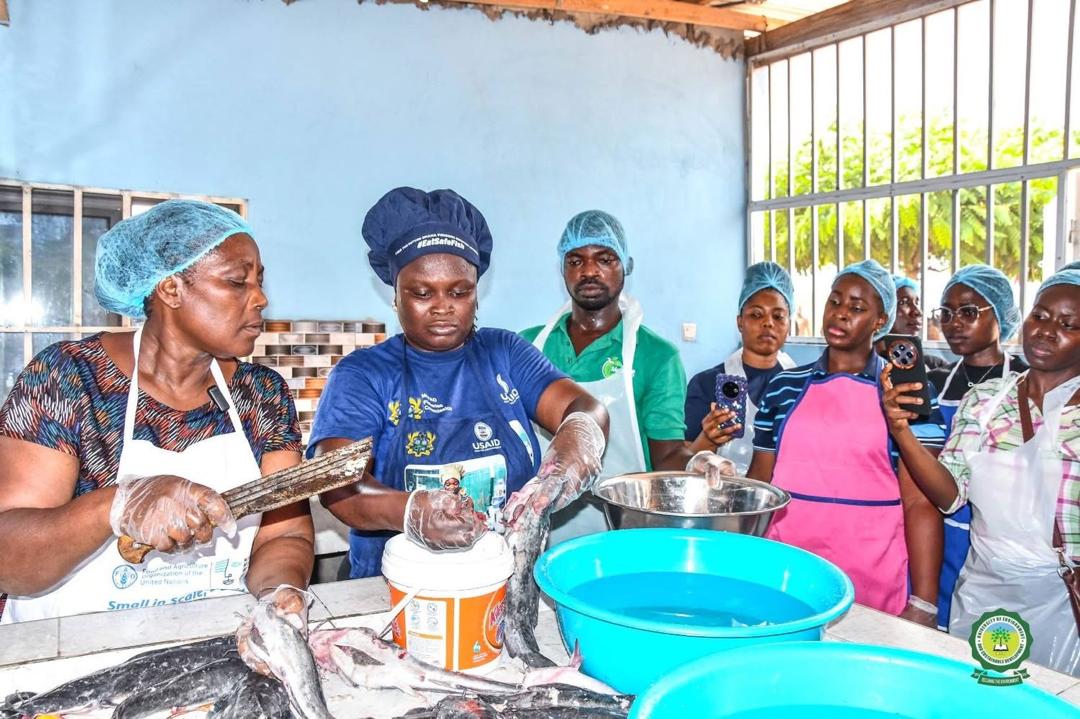
The University of Environment and Sustainable Development (UESD), through the Nkabom Collaborative Project, has trained 70 young people and agribusiness practitioners in fish processing technology to enhance employment and entrepreneurship opportunities.
 The project, in partnership with the Mastercard Foundation and McGill University, trained youth, fish processors, agribusiness practitioners, students, and extension officers in fish processing technology. The five-day intensive programme brought together 70 participants in two cohorts from communities across the Eastern, Greater Accra, Ashanti, Volta, and Upper East Regions.
The initiative aims to improve livelihoods and create sustainable employment opportunities for young people aged 18 to 35 by equipping them with practical skills in aquaculture, fish processing, preservation, food safety, branding, and entrepreneurship.
Welcoming participants, the Education Pillar Lead of the Nkabom Collaborative-UESD, Prof. Richard Amfo-Otu, speaking on behalf of Project Coordinator Prof. Edward Wiafe Debrah, described the training as an innovative intervention to build capacity in aquaculture and agro-processing. He noted that UESD is implementing the project in partnership with KNUST, Ashesi University, Koforidua Technical University, UHAS, and the Association of Ghana Industries, with focus areas including aquaculture, agro-waste technology, entrepreneurship, and student success initiatives.
The Aquaculture Lead, Dr. Christian Larbi Ayisi, outlined the objectives, noting participants were trained in post-harvest handling, fish spoilage prevention, preservation techniques, quality assurance, branding, marketing, and fish-smoking technologies. He encouraged them to adopt international food safety standards and explore export opportunities.
A practical field session was held at Atimpoku, where participants received hands-on training from experienced fish processor Madam Doris Hagan. They engaged in fish cleaning, preparation, smoking, packaging, and value addition, as well as converting fish by-products into fish oil, fertiliser, and powdered fish products.
Participants described the training as practical, insightful, and transformative, saying it improved their understanding of fish processing, preservation, packaging, and marketing, and inspired interest in fish-processing entrepreneurship.
At the closing ceremony, the Project Investigator and Vice-Chancellor, Prof. Eric Nyarko-Sampson, expressed satisfaction with the outcomes and urged participants to share knowledge and utilise opportunities through the UESD Innovation and Business Hub for business development. He emphasized the programme’s hands-on nature and encouraged networking and collaboration, assuring continued support for youth skills development in aquaculture and agribusiness.
Representatives of the UESD Innovation and Business Hub introduced participants to opportunities in entrepreneurship development, mentorship, networking, grant writing, and business incubation.
At the end of the programme, certificates were awarded to 41 participants who successfully completed the training.
By Emelia B. Addae