
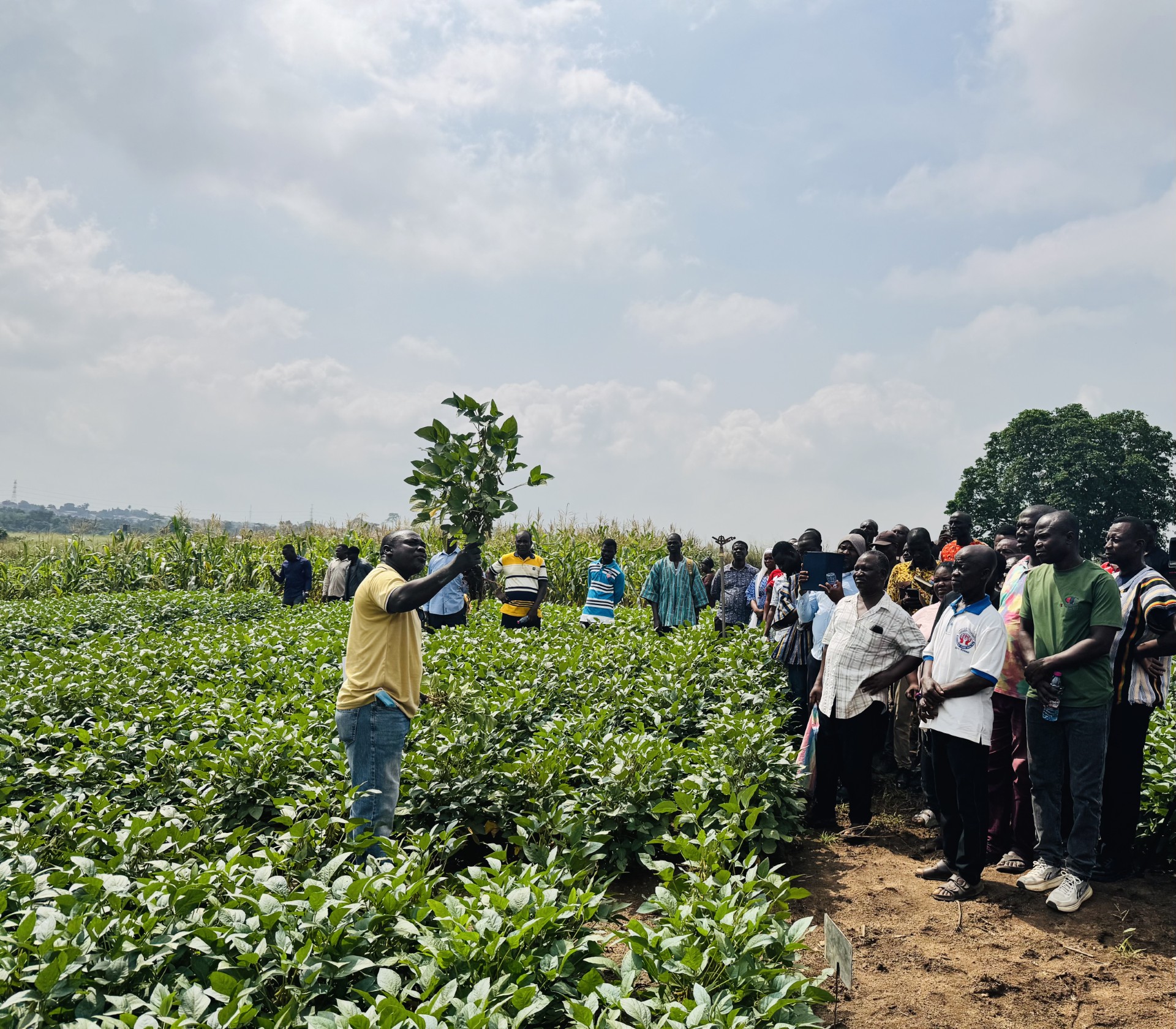
Researchers at the Council for Scientific and Industrial Research-Crops Research Institute (CSIR-CRI) have proposed the supply and application of limes in agricultural lands, instead of fertilizers, to help reduce the high levels of soil acidity in Ghana.
 According to them, the continuous use of acidifying fertilizers such as urea and sulphate of ammonia, have resulted in the built up of aluminium oxides and thereby, causing soil PH levels to constantly reduce.
They again, pointed out that, most of agricultural limes have some level of nutrients such as magnesium and calcium, which are of great benefit to the soil.
“If government is intending to provide fertilizers to farmers, we are asking government to look at a holistic approach of reducing soil acidity by making lime available for farmers to help make their soils more productive than becoming fertile at a point and not able to sustain agricultural production”, Dr. Kennedy Agyemang, Principal Research Scientist, of CSIR-CRI, stated.
Speaking to farmers and stakeholders at an agricultural lime demonstration day at Fumesua, in the Ejisu Municipality, Dr Agyeman, explained that Ghana had a lot of lime deposits.
What is needed is investment in the production of the soil conditioner for agricultural purposes.
Dr Agyeman pointed out that, lime was not expensive, “but the problem has been that, it is not available in every corner unlike fertiliser so the farmer in the hinterland can readily grab”.
This, he indicated, was why it was important for the government’s push and investment to make agricultural lime affordable and available to farmers.
Dr Agyemang, emphasising the essence of education and utilisation of lime for agriculture in Ghana, noted that, soils in the country were increasingly becoming acidic – a situation hindering agricultural boost and productivity, highlighting the need for farmers to be aware of the underlying causes for the infertile soils they are using for production.
A survey conducted by the Soil Research Institute in the Bosome Freho and Bosomtwi Districts, showed 68 percent of soils were acidic.
The Researcher noted that, the CSIR-CRI was very particular about soil fertility management and not always the quantity of fertilizer applied to a soil.
“If the soil is not in good health, the quantity of fertilizer that one will apply will still not be able to yield the desired or potential yields of the crop.
When soils are very acidic, they do not release nutrients for crops to use them and some nutrients that are very important for crops to use are held up in acidic soils.
If any intervention is aimed at making the soils we should look beyond fertilizer application, and tackle the main obstacles (acidity) that is making the nutrients not available to the soil, he stated.
Dr Agyeman explained that agricultural limes were very important because they raised the pH of the soils and when that was done nutrients were not held up in the soil since it could be released easily for crops to utilise them.
By Florence Afriyie Mensah, GNA