
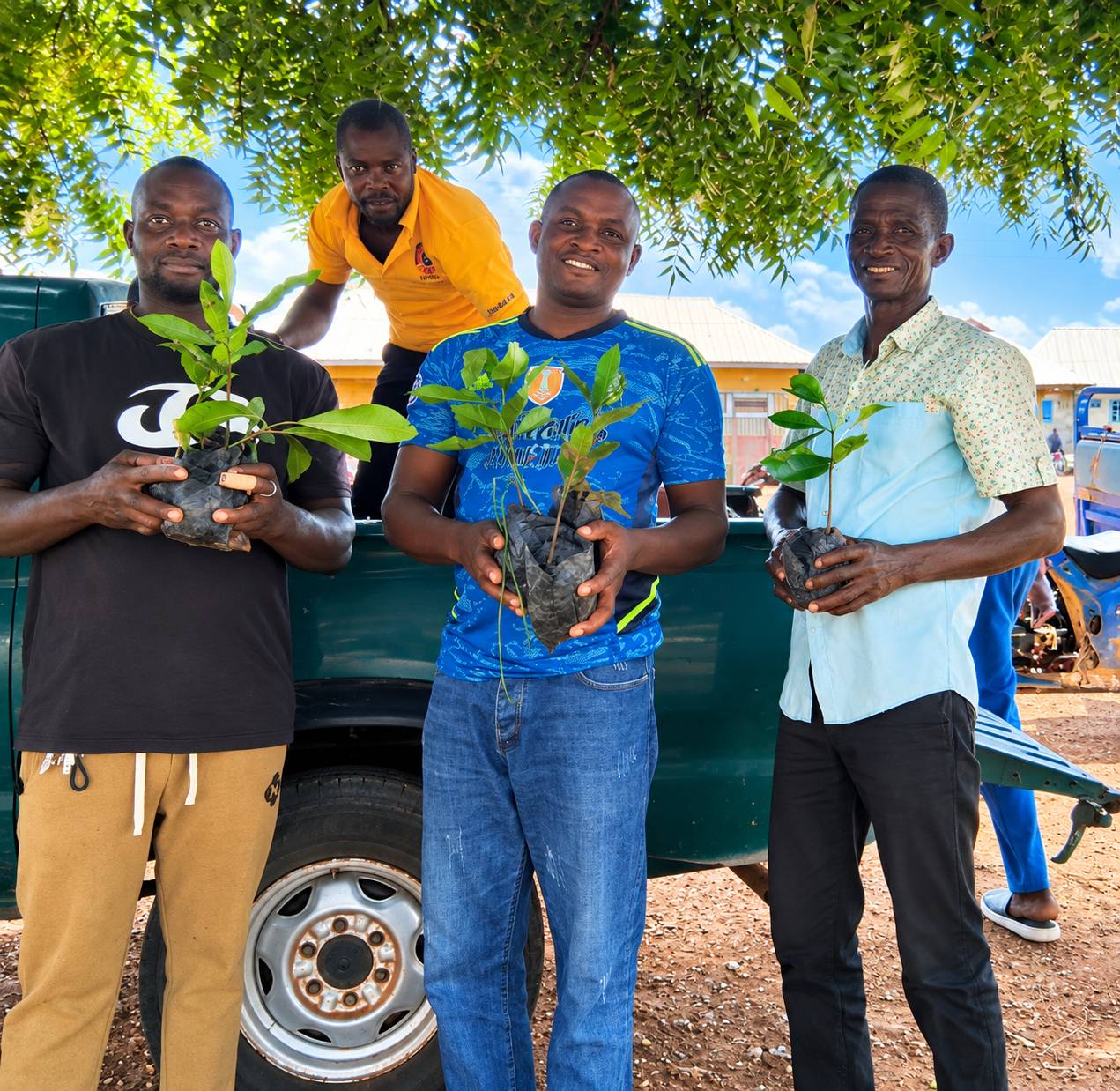
The Council for Scientific and Industrial Research-Savanna Agriculture Research Institute (CSIR-SARI) has distributed 2,500 tree seedlings to 14 communities in the Upper East and Upper West Regions as part of efforts to help mitigate climate change.
 The initiative, under the Sahelian Landscapes: A Land of Opportunities (LOGMe II) project, also aims to promote climate adaptation, restore degraded agricultural lands, and improve food security.
Dr Iddrisu Yahaya, Head of Department, CSIR-SARI, Wa Office, who revealed this to the Ghana News Agency (GNA) in an interview in Wa, added that the tree seedlings included 1,000 mango, 1,000 cashew and 500 moringa seedlings.
The LOGMe II project is being implemented by the CSIR-SARI in the two regions in partnership with the International Union for Conservation of Nature (IUCN) and seeks to promote agroforestry as a climate-smart and income-generating agricultural practice.
The project is being implemented in seven communities in the Talensi and Builsa South districts in the Upper East Region, and seven communities in the Sissala East and Jirapa Municipalities in the Upper West Region.
Dr Yahaya said each community is expected to establish about one and a half acres of cashew agroforestry and at least one acre of mango plantations as part of efforts to restore agricultural lands.
The initiative would translate to about three acres of agroforestry in each of the 14 beneficiary communities, with a cumulative land area of at least 42 acres to be covered across the 14 communities.
“Our forest cover in the Upper West and Upper East has depleted, and that has consequences on the amount of rainfall we get
So, to restore our vegetation, we are encouraging this agroforestry, which is a climate-smart and income-generating activity, and will also ensure food security”, he explained.
Dr Yahaya said they would monitor and assess the progress of the tree-planting activities to ensure the agroforestry is properly established.
He said the integration of trees into farming systems would help address the issue of land degradation, which affects agricultural production and livelihoods in the two regions.
The LOGMe II project is being implemented by IUCN in Ghana, Burkina Faso, Niger, Benin and Senegal, with funding from the Italian Ministry of Environment and Energy Security through the United Nations Convention to Combat Desertification (UNCCD) Global Mechanism.
The project seeks to address land degradation and promote sustainable livelihoods in Sahelian communities affected by climate change.
In Ghana, the project is being implemented by a consortium of organisations, including CSIR-SARI in the Upper East and Upper West regions.
In the Upper West Region, the project is being implemented in Ulkpong, Dogoh and Dazugri in the Jirapa Municipality, and Sakalu, Nanchalla, Pieng and Basisan in the Sissala East Municipality.
Philip Tengzu, GNA