
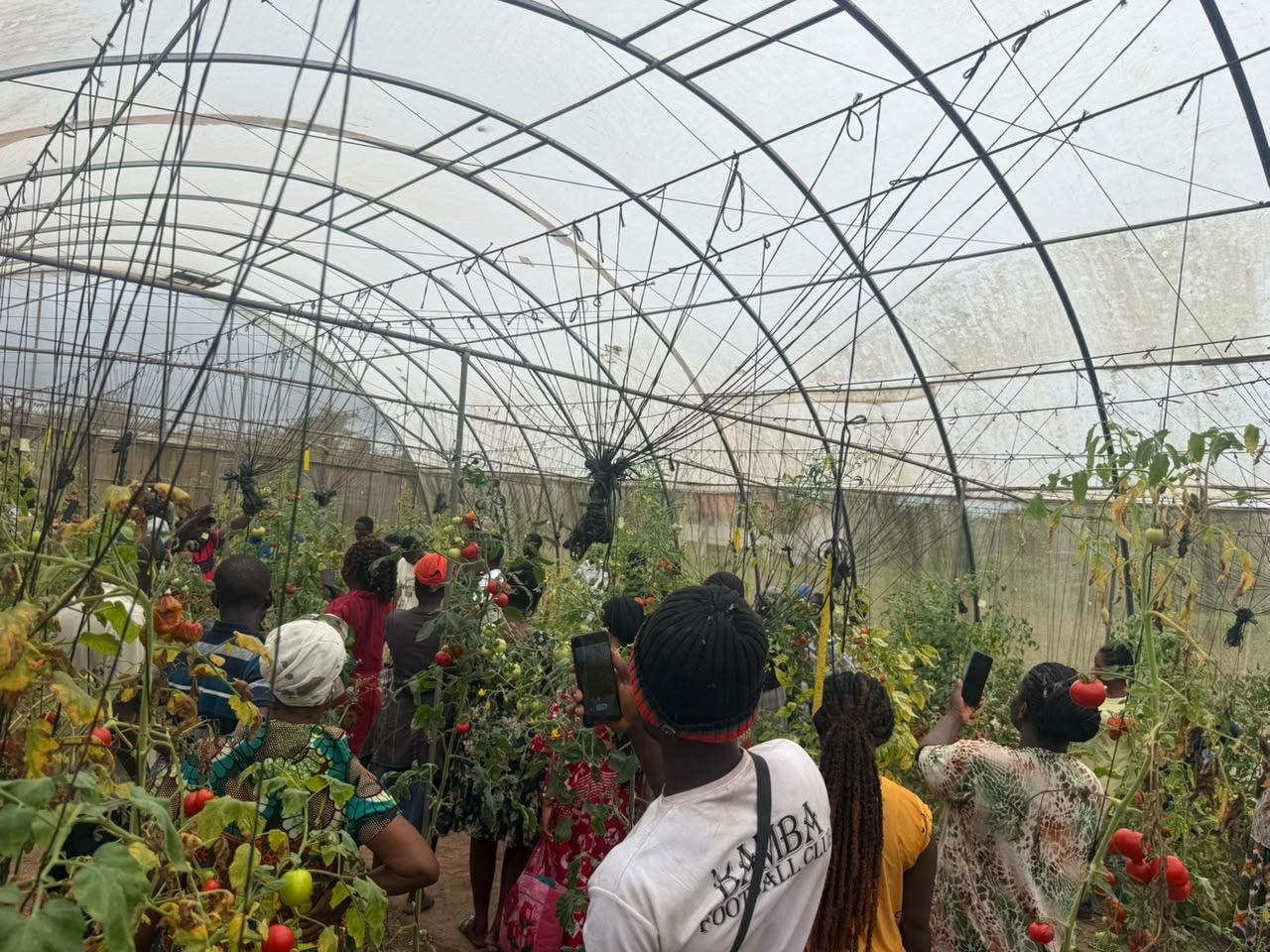
The Council for Scientific and Industrial Research-Crops Research Institute (CSIR-CRI), with funding from KOPIA Ghana, has trained more than 100 farmers and agricultural extension officers in greenhouse tomato production.
 The training is aimed at supporting Ghana’s efforts to reduce tomato imports and achieve self-sufficiency in tomato production.
Two separate training sessions, involving about 50 participants each, were held at Akumadan in the Offinso North District of the Ashanti Region and Dormaa East in the Bono Region for beneficiary farmers and extension officers.
Dr Michael Kwabena Osei, Principal Research Scientist and Tomato Breeder at CSIR-CRI, said the project focused on evaluating climate-smart tomato lines, demonstrating improved varieties and building the capacity of farmers in greenhouse technologies.
He said open-field tomato production was characterised by low yields, poor quality and high incidence of pests and diseases, while greenhouse varieties on the market were expensive hybrids.
“The CSIR-CRI has developed affordable inbred and open-pollinated lines that yield as high as the expensive hybrids. With low-cost screen houses built from local materials, our farmers can produce quality tomatoes all year round and reduce imports,” he assured.
The participants were taken through practical sessions covering production from nursery to harvest.
These included the use of seed-tray nurseries with insect nets to prevent the whitefly-transmitted Tomato Yellow Leaf Curl Virus (TYLCV), yellow traps for pest monitoring, trellising and staking, drip irrigation, fertigation, and disease management.
Mr Prosper Adelwini, Offinso North District Director of Agriculture, commended CSIR-CRI and KOPIA Ghana for the practical training, describing it as timely for farmers who were losing up to 40 per cent of their produce to diseases in open fields.
Madam Akosua Serwaa, a farmer who participated in the training at Dormaa East, said the training had demonstrated how tomatoes could be cultivated under hygienic and controlled greenhouse conditions.
She appealed for support with seeds and the construction of greenhouses to enable farmers to adopt the technology and reduce losses associated with market gluts.
By Florence Afriyie Mensah