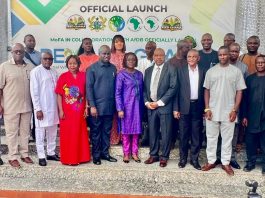
The Ghana Association of Agricultural Economists (GAAE) has called for stronger collaboration among policymakers, researchers, development partners and agribusiness operators to address persistent challenges confronting Ghana’s agricultural sector.


The Association said tackling low agricultural productivity, climate-related shocks, inadequate investment, post-harvest losses and unequal access to improve upon technologies, required coordinated action informed by research, innovation and evidence-based policies.
Professor John K. M. Kuwornu, the President of GAAE, made the call at the opening of the Association’s Ninth Annual Conference at the University of Ghana, under the theme: “Inclusive Agri-Food Systems Transformation; Evidence for Policy, Practice, and Sustainable Development.”
He said although the agricultural sector had recorded encouraging progress, including a real sector growth rate of 6.8 per cent and food inflation of 4.9 per cent in December 2025, significant structural challenges continued to undermine its full potential.
Prof. Kuwornu, who is also the Pro Vice-Chancellor of the University of Energy and Natural Resources, identified the crop-biased farming system, ageing farmer population, low financial investment and limited access to improve upon technologies among the issues requiring urgent attention.
He said initiatives such as the Feed Ghana Programme, Nkoko Nkitikiti and the 24-Hour Economy offered opportunities to improve upon the welfare of farming households, but their impact would depend on effective implementation, research support and inclusive stakeholder participation.
He reaffirmed GAAE’s readiness to partner the Ministry of Food and Agriculture and other relevant institutions to advance agricultural transformation through policy formulation, advocacy, extension services and evidence-based decision-making.
Prof. Kuwornu said the annual conference, since its inception in 2017, had provided a platform for agricultural economists and researchers from allied disciplines to examine critical development issues, share research findings, build professional networks and mentor emerging scientists.
The 2026 conference brought together students, early-career researchers, academics, policymakers, development partners and experts from national and international institutions to deliberate on policies and practical interventions for sustainable agricultural development.
Prof. Kuwornu said the discussions were expected to generate practical ideas and innovations to improve upon the productivity of farming households and agribusinesses across Africa.
He noted that the conference themes were aligned with the United Nations Sustainable Development Goals, the African Union’s Agenda 2063 and Ghana’s development aspirations.
Prof. Kuwornu expressed appreciation to the Local Organising Committee, co-chaired by Prof. Freda E. Asem and Dr Collins Asante-Addo, for coordinating the conference.
He acknowledged the contributions of sponsors and partners, including the NKABOM Collaborative of the University of Ghana, GIRSAL, Action Aid Ghana, ADB, AGI, NIRAS, the Department of Agricultural Economics and Agribusiness of the University of Ghana and the Council for Scientific and Industrial Research-Science and Technology Policy Research Institute (CSIR-STEPRI) towards the annual conference.
He called for sustained support from the partners and other stakeholders to strengthen the Association’s contribution to agricultural research and policy development.
Additionally, evidence-based policymaking, research-driven innovation and sustainable investment were essential to improving productivity, strengthening food security and creating economic opportunities across the agricultural value chain.
Dr Peter Boamah Otokunor, Presidential Adviser on Agriculture and Agribusiness called for an inclusive agricultural transformation agenda that went beyond increasing food production to ensuring that smallholder farmers, women and young people had access to productive resources, technology, affordable financing and reliable markets.
He stressed that agricultural modernisation should not benefit only large commercial enterprises but should create opportunities across the entire food value chain.
Ghana imported more than GH¢36.5 billion (about US$3 billion) worth of food in 2025, representing over 22 per cent of total imports, despite its agricultural potential.
Dr Otokunor said the situation exposed weaknesses in domestic production efficiency, post-harvest management, storage and market systems.
While, post-harvest losses cost Ghana about US$2 billion annually.
He estimated that post-harvest losses had reached US$2 billion, with yam alone accounting for about US$560 million.
He identified inadequate storage as a major contributor to grain losses, estimated at between 38.5 and 45 per cent, while Ghana continued importing cereals and rice.
The Presidential Initiatives in Agriculture and Agribusiness (PIAA) was working on an investment project to establish smart silo grain-buffer storage facilities with a combined capacity of one million metric tonnes at 10 strategic production locations nationwide.
The facilities would be equipped with dryers and cleaners to reduce post-harvest losses and provide reliable supplies of raw materials for agro-processing and industrialisation.
Mr Eric Opoku, the Minister for Agriculture whose speech was read on his behalf challenged agricultural economists to ensure that research findings translated into practical decisions that could improve farming outcomes, particularly before the next planting season.
Farmers’ incomes must matter as much as increased production and emphasised that higher agricultural yields alone did not necessarily translate into better livelihoods, citing the example of a maize farmer whose increased harvest could still result in poor returns because of low market prices.
The Minister said the Government had a responsibility to account to farmers and taxpayers for the outcomes of investments in agriculture, including improved seeds, irrigation, Farmers’ Service Centres and support for crop and livestock producers.
The ministry, he noted would establish a Research–Policy Desk within the Ministry of Food and Agriculture to strengthen the connection between academic research and policymaking.
Mr. Opoku called on the Association of Agricultural Economists to collaborate with the Ministry’s technical directorates in designing the proposed desk, drawing on the expertise of ISSER, CSIR-STEPRI, universities and technical universities to advance food security in the country.
By Mildred Siabi-Mensah, GNA