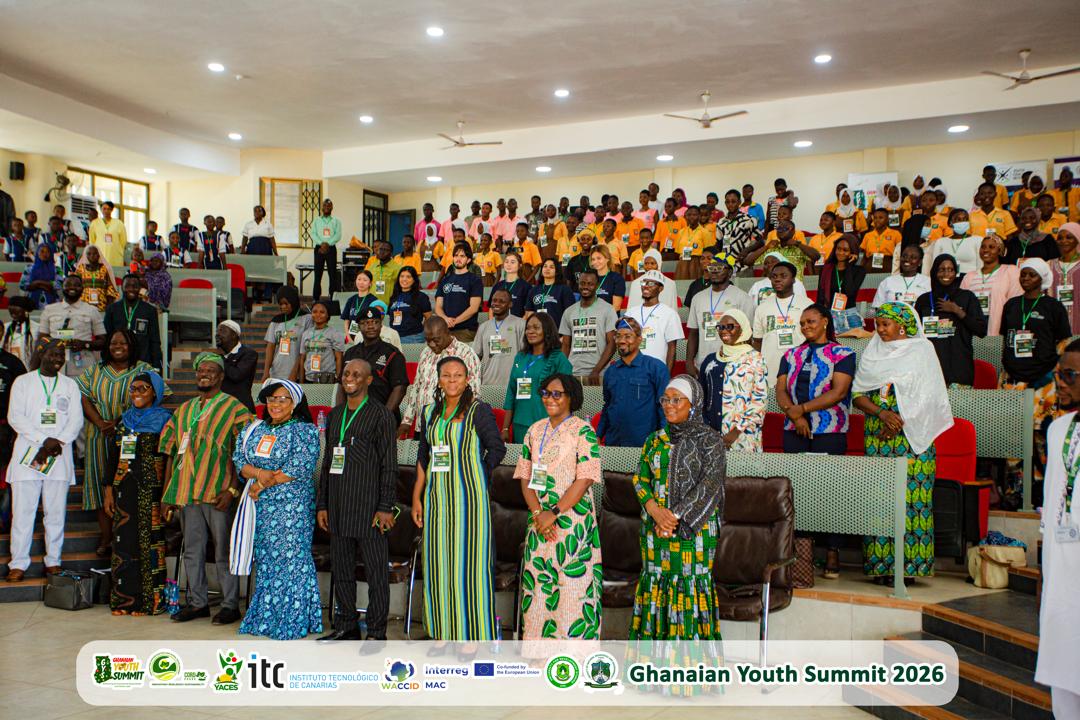
More than 300 young people and stakeholders gathered in Ghana’s Northern Region to explore how the green economy can create employment opportunities, promote entrepreneurship and address pressing environmental challenges.

The summit brought together more than 300 participants, including young people, entrepreneurs, students, academics, development practitioners and government representatives to discuss opportunities within the green economy.
Organised by the Center for Opportunities and Rural Development (CORD Ghana), in partnership with the Faculty of Natural Resources and Environment at the University for Development Studies (UDS), the event received support from the WACCID Project under the INTERREG MAC Programme, through the Canary Islands Institute of Technology.
Discussions focused on how green entrepreneurship could provide practical solutions to climate change, environmental degradation and unemployment, particularly among young people.
Key areas explored included climate-smart agriculture, renewable energy, waste management and recycling, biodiversity conservation, sustainable natural resource management and the circular economy.
Addressing participants, CORD Ghana Executive Director, Dr Kodimah Siita, encouraged young people to look beyond conventional employment opportunities and consider environmental conservation as a foundation for entrepreneurship and business innovation.
He highlighted the potential of green enterprises to generate sustainable livelihoods while contributing to the protection and responsible use of natural resources.
The Vice-Chancellor of UDS, Professor Mohammed Muniru Iddrisu, emphasised the importance of connecting academic research with the practical needs of communities.
He called for stronger collaboration among universities, government institutions, civil society organisations and the private sector to translate research and innovation into solutions that address development challenges.
Speaking on behalf of the Regional Minister, Hon. Rosina Zeinab Abdul-Rahaman encouraged young people to take an active role in regional development through entrepreneurship, skills acquisition and responsible natural resource management.
CORD Ghana’s Head of Programmes and Policy, Esther Nyamekye Opoku, stressed the need for increased investment in youth training, green finance, mentorship and business incubation.
She underscored the importance of making these opportunities accessible to rural young people, women and persons with disabilities to ensure that the transition to a green economy is inclusive.
Participants also identified several challenges facing young people interested in establishing green businesses. These included limited access to finance, technical skills, business development support and reliable markets.
The discussions highlighted the need to move beyond raising awareness about environmental sustainability towards creating an enabling environment where young people can develop viable businesses, access resources and turn innovative ideas into sustainable enterprises.
The summit concluded with a call for stronger partnerships among public institutions, universities, development organisations and private businesses to expand opportunities for youth-led green enterprises.
As Ghana continues to confront environmental challenges and youth unemployment, investing in green skills and entrepreneurship could help position young people as key contributors to sustainable economic development.
From climate-smart agriculture and renewable energy to recycling and biodiversity conservation, the green economy offers opportunities to create jobs while protecting the natural resources on which communities and future generations depend.