
Across West Africa, smallholder farmers and peri-urban families face an escalating, invisible threat: extreme micro-climate heat. According to seasonal climate trend reports from the Nigerian Meteorological Agency (NiMet) and the World Meteorological Organization (WMO), ambient dry-season shade temperatures across the West African inland belt routinely climb past 40°C.
 However, macro-scale weather broadcasts significantly understate human thermal exposure at the household level. Studies in tropical building thermodynamics published by UN-Habitat and the Journal of Building Engineering confirm that uninsulated corrugated zinc and iron roofing sheets—the dominant building materials in informal settlements—absorb intense solar irradiance (800–1000 \text{ W/m}^2), driving inner roof surface temperatures between 55°C and 62°C. This conductive radiant heat transfer turns living spaces into high-load heat traps where real-feel thermal stress routinely exceeds 45°C.
While international climate forums discuss macro-adaptation strategies, frontline agricultural communities need practical, nature-based solutions operating directly at the household level.
Historically, tree-planting drives across tropical Africa have suffered dismal retention rates—often seeing 70% or more of newly planted saplings perish within their first dry season due to livestock damage, drought, or fuelwood cutting. To solve this systemic failure, the Ubuntu Green Climate Foundation (UGCF) engineered the Kuje 100 Green Corridor Initiative in Abuja, Nigeria, establishing an adaptable template for smallholder heat mitigation across West Africa.
Agronomic Precision: The 5-Month Hardening Protocol
A major cause of seedling mortality in tropical reforestation is transplant shock caused by deploying fragile nursery stock straight into harsh field conditions.
To overcome this, the UGCF technical team implemented a rigorous five-month nursery hardening pipeline:
Root Architecture Fortification: Saplings were cultivated in high-volume containers to develop deep, robust taproots prior to field integration.
Hydration Stress Cycles: Seedlings were subjected to controlled watering cycles to build cellular drought tolerance.
Strategic Wet-Season Timing: Deployment was synchronized with the peak West African rainy season (June 2026), giving young root systems optimal soil moisture during their initial establishment phase.
Species Selection: Decoupling Trees from Firewood Pressure
Selecting Moringa oleifera was a deliberate agro-ecological strategy. In many West African rural communities, young trees are routinely felled for cooking fuel during harsh dry spells.
Moringa, however, features soft, high-moisture spongy wood that makes it unsuitable for firewood. This characteristic permanently shields the living canopy from fuel harvesting, while providing smallholders with high-value nutritional yields from its leaves and seed pods year-round.
The Mandatory Stewardship Model (MSM)
To ensure long-term asset protection without expensive imported infrastructure, UGCF introduced the Mandatory Stewardship Model (MSM):
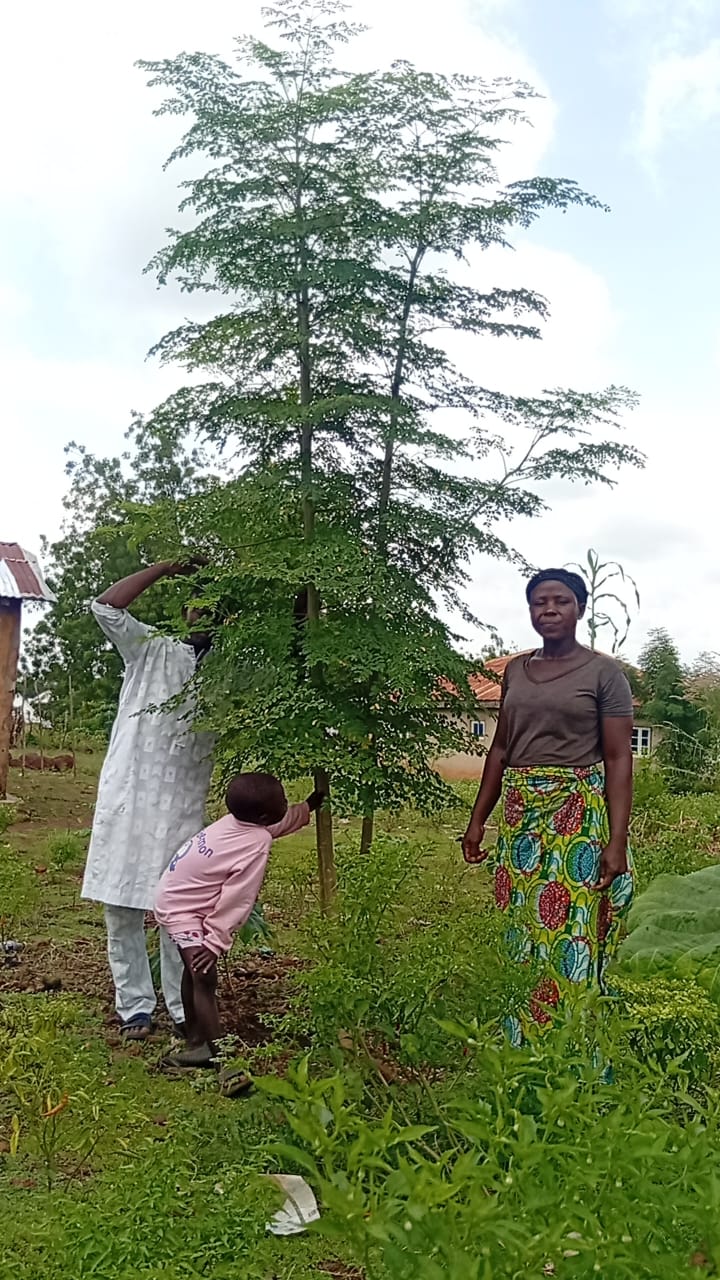
Dual-Custody Ownership: Each tree node is assigned to a household, co-managed by Parent Custodians and Junior Guardians (children building early climate stewardship).
Community “Human Fences”: Utilizing local agro-waste and low-cost materials—such as branch tipis, recycled mesh netting, and agricultural sack shields—families construct protective barriers that effectively block grazing livestock.
Results & Regional Scalability
Across 100 mapped smallholder nodes in five geowards, the project has maintained a >95% tree survival rate. In just four months post-transplant, these Moringa trees have reached heights of 8 to 10 feet, creating dense shade umbrellas capable of filtering 40–50% of direct solar radiation and targeting an indoor ambient temperature reduction of 3–5°C ahead of peak heat waves.
Phase 2 builds further on this foundation by adding clean, decentralized solar lighting beneath mature canopies, transforming these shade footprints into illuminated evening spaces for family gatherings and cultural storytelling.
For agricultural extension workers, climate-smart practitioners, and development organizations operating across Ghana, Nigeria, and the wider ECOWAS region, the Kuje model proves a vital point: combining precision agronomy with structured community ownership creates living, self-sustaining green infrastructure that protects public health, food security, and rural livelihoods from the ground up.
About the Author:
By Nafesat Lawal
Nafesat Lawal is an agricultural scientist, systems designer, and Lead Project Architect at the Ubuntu Green Climate Foundation (UGCF).