

The Maximizing Gains from Cashew Production for Youth Development Project (MA-CASH) has been hailed as a transformative initiative aimed at reducing post-harvest losses in Ghana’s cashew industry.
 The initiative was also praised for creating sustainable employment opportunities for young people.
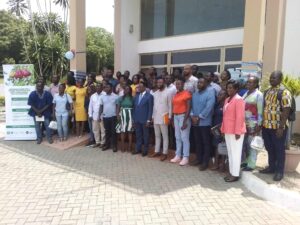
Addressing stakeholders during a forum in Accra, presenting the findings and feasibility of the MA-CASH project and cashew fair, Mr. George Asare, a researcher involved in the project study, revealed staggering statistics about the cashew industry.
The Council for Scientific and Industrial Research – Food Research Institute (CSIR-FRI) organized the forum in partnership with Opportunity International Savings and Loans Limited as part of MA-CASH) project, with funding support from the International Development Research Centre (IDRC) through the Ministry of Environment, Science, and Technology (MEST).
Mr. Asare reported that Ghana produced 1,610,000 metric tons of cashew apples in 2024, yet a shocking 90 percent of these apples went to waste due to inadequate processing infrastructure.
“This translates to an astonishing 1,449,000 metric tons of lost produce,” Mr. Asare noted, and called it “a significant economic and nutritional setback for the nation.”
He noted that cashew apples are rich in vitamin C, antioxidants, and bioactive compounds. This makes cashew apples valuable for human nutrition.
He stressed that rather than allowing them to go to waste, Ghana should focus on transforming them into consumable products, as other countries have successfully done.
The MA-CASH project, piloted in the Bono and Bono East regions, aims to enhance the technical, economic, and environmental feasibility of cashew processing in Ghana.
The initiative seeks to convert cashew waste into valuable products such as juices and other byproducts, thereby creating new economic opportunities.
A key aspect of the project is its emphasis on youth and women empowerment, addressing the growing concern of youth migration due to limited job opportunities.
The research findings indicated that 85 per cent of farmers expressed their readiness to adopt improved harvesting and post-harvesting practices if linked to reliable buyers or processing facilities.
Additionally, 91 per cent of farmers showed their willingness to implement sustainable waste management strategies to maximize cashew production benefits.
Dr. Francisca Aba Ansah, lead researcher of the MA-CASH project, emphasized the need for strong support in cashew apple processing as a means of reducing youth unemployment and migration.
She outlined three key focus areas of the project: technology transfer, agro-biodiversity enhancement, and digital inclusivity.
She explained that the first objective aims to improve and transfer processing technologies for cashew apples and their byproducts in collaboration with farmers, ensuring sustainability and zero waste in production.
The second area focuses on agro-biodiversity, particularly the integration of bee farming to enhance cashew nut yields while generating alternative income sources for farmers.
Lastly, the project promotes digital inclusivity, providing an online trading platform to connect cashew processors, farmers, and aggregators.
According to Dr. Ansah, since its inception in April 2024, the project has reached over 250 farmers, the majority of whom are women, across six communities in the Bono East and Bono regions.
She highlighted that the research examined various cashew apple blends, including pineapple, mango, ginger, and apple-based juices, which underwent consumer acceptability testing.
Findings showed that cashew-mango was the preferred blend, followed by pineapple, ginger, and apple.
Adding to beverages, the project explored meat alternatives, fortifying cashew-derived plant-based protein with Bambara beans to produce sausages, pastries, and kebabs.
She noted that vegan consumers showed a strong preference for cashew-based meat substitutes, indicating their commercial viability.
Farmers and processors were trained in harvesting techniques, hygienic handling, value addition, and waste management to ensure effective product adoption.
Prof. Charles Tortoe, Director of CSIR-FRI, welcomed stakeholders and highlighted the importance of scientific and technological support for Ghana’s food and agricultural sectors.
He said that the CSIR-FRI, accredited to ISO/IEC 17025 (2017), provides comprehensive analytical services to both local and international industries.
He explained that the MA-CASH project was developed to address cashew fruit waste, poverty alleviation, and youth-led sustainable economic growth.
He urged key stakeholders, including MEST, Ministry of Food and Agriculture, and the Tree Crop Development Authority, to support the expansion of the project into other cashew-growing areas.
In an address read for him, Mr. Cephas Adjei Mensah, Director of Research, Statistics, and Information Management at MEST, described the MA-CASH project as a milestone in Ghana’s agricultural innovation and youth empowerment efforts.
He noted that while the cashew sector holds great potential for Ghana’s economy, the focus has largely been on cashew nuts, neglecting the valuable cashew apple, which is often discarded as waste.
“The MA-CASH project has sought to change this narrative by developing innovative approaches to cashew apple processing, creating new value chains, and empowering youth in the agricultural sector,” he stated.
Dr. Emmanuel Kyereh, a food scientist at CSIR-Food Research Institute, had indicated that the project extended beyond processing cashew apples to include a comprehensive youth support programme.
“This holistic approach ensures that we are not only developing technologies but also building the capacity of our young people to utilise these innovations for economic empowerment,” he said.
The project has also fostered partnerships with financial institutions such as Opportunity International Savings and Loans, which has played a key role in providing financial support to businesses within the cashew fruit value chain.
Mr. Mensah further stated that the MA-CASH project aligns with Ghana’s national development agenda, promoting value addition in agriculture, employment creation, waste reduction, and sustainable resource utilization.
He also urged stakeholders to scale up the technologies and approaches developed through the project to benefit more communities across the country.
“As stakeholders celebrate the achievements of the MA-CASH project, we should look forward to disseminating findings into policy briefs, strengthening partnerships, and attracting further investment into cashew apple processing,” he added.
With cashew processing offering a viable pathway for economic growth, the MA-CASH project presents a strategic solution to youth unemployment and migration.
By D.I. Laary