

Maphlix Farms at Dawhenya in the Greater Accra Region is to supply 3,000 tonnes of tomatoes to the domestic market to help address Ghana’s production shortfall.
 The move is part of ongoing measures to reduce the country’s tomato deficit and stabilise supply following recent import constraints from neighbouring countries.
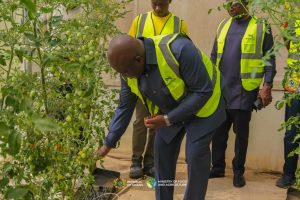
A statement issued by the Ministry of Food and Agriculture, said Mr Eric Opoku, the sector minister, disclosed this during a working visit to Maphlix Farms, where he assessed production activities and discussed strategies to scale up output.
It said the farm is expected to produce 3,000 tonnes by year-end, with additional output from expanded open-field cultivation.
The statement said harvesting had begun, with produce picked every three days to ensure a steady supply.
It said the combination of greenhouse and open-field systems was expected to support year-round production and reduce seasonal shortages that often drive price increases.
The Ministry said it was collaborating with research institutions, including the Council for Scientific and Industrial Research (CSIR), to improve seed quality and develop climate-resilient varieties to enhance yields and shelf-life.
It said that these measures aimed to address concerns among traders and consumers about the durability and quality of locally produced tomatoes.
The statement noted that increased private sector participation, such as Maphlix Farms’ operations, was critical to closing the supply gap and reducing dependence on imports.
It assured the public of continued efforts to boost local production and urged traders and consumers to remain calm as interventions take effect.
The Ministry said that Maphlix Farms planned to expand production and explore processing options to reduce post-harvest losses and support value addition in the tomato value chain.
By Edward Acquah, GNA
Pls kindly tell Dr.Kamasa to pay us we clear the place plant the tomatoes n left 7z without pay us God is watching every one n his work
Hmmmm!!! Maphlix? an institution operating under the cover of vegetable production and skills training to exploit vulnerable youth, women, and persons living with disabilities. An institution that subjected its First Cohorts of Trainees to harsh physical, emotional, and psychological conditions during the programme, with key promises such as allowances, transitional support and certification not fulfilled. Trainees are now demanding their certificates and accountability, but there appears to be silence from Maphlix. Maphlix operational operandi is purely exploitative and lack transparency.
THE PROBLEM OF GHANA:>
LEADERSHIP
Eii did I hear Maphlix?
A company that has carried itself as credible that could not even fulfill its duty to its trainees.
A so called five months vegetable production program that lacks a road map, effective communication, lack of respect for trainees and seems not to have in good and sounding preparation before the commencement of the program. A company that intended to train Ghanaian youth which along the line subjected trainees to pure labour. loading and offloading of yams, fertilizers, potatoes etc. working from Monday to Saturday and even sometimes Sundays yet feed with banku and raw pepper.
Total silence on the promise of giving trainees allowances, loans and grant acquisition after the program.
A company that undermined the safety of trainees but only focused on its profitability.
Trainees who got injured were could not get any attention and was left in their predicament
A program that ended in early December 2025.
We are in April 2026, and nothing has been done about certification. Maphlix lacks effective communication due to lack of respect it has for its trainees (first cohort)
Hmm Talking of Maphlix I can only say I have now understand the saying “from afar every picture looks different”
With this behaviour Ghana will not prosper