
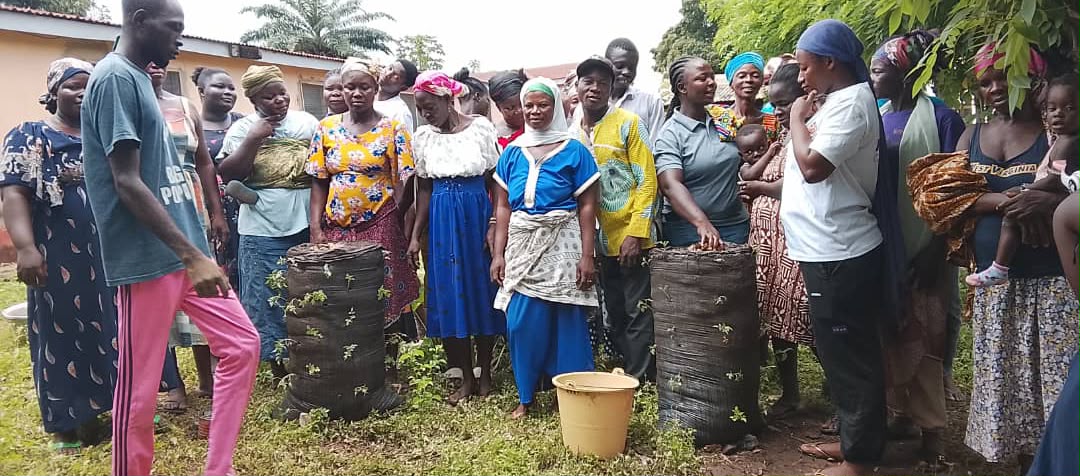
Women farmers in the Nkwanta South Municipality of the Oti Region are strengthening their capacity to adapt to climate change through practical climate-smart agricultural techniques aimed at protecting their farms, livestock and household food supplies against the impacts of El Niño.
 The Iseguri Initiative recently organised a two-day training programme to equip smallholder women farmers with affordable and practical strategies for managing the effects of rising temperatures, reduced water availability and increased wildfire risks.
With temperatures in the region projected to reach 36°C, the training focused on helping participants adopt sustainable farming practices that conserve water, improve soil health and sustain agricultural production under increasingly challenging weather conditions.
Empowering Women Farmers to Build Climate Resilience
Opening the programme, Rejoice Selorm Azameti, the Nkwanta South Municipal Women in Agricultural Development (WIAD) Officer, highlighted the important contribution of women farmers to household livelihoods and regional food security.
She encouraged the participating group leaders to take advantage of the training by actively engaging in the sessions and acquiring practical knowledge they could share with other women farmers in their communities.
She emphasised that transferring the knowledge gained would help extend the benefits of the programme beyond the direct participants and strengthen community-wide resilience to climate-related challenges.
Jemima Etse, the focal person for the Iseguri Initiative, drew attention to the environmental challenges facing farmers, particularly the threats posed by high temperatures and strong winds to crop production and livestock management.
She explained the need for farmers to adopt appropriate adaptation measures to minimise potential losses and maintain agricultural productivity.
Practical, Low-Cost Solutions for Climate-Smart Agriculture
The training introduced participants to several affordable techniques for adapting their farming activities to changing climatic conditions.
Raymond Buami, Programme Coordinator, highlighted the importance of prioritising household food production through sack gardening. The technique allows households to grow vegetables in sacks, making it a practical option for families with limited access to land.
He advised participants to water their sack gardens after 6:30 p.m. to reduce water loss through evaporation and improve water-use efficiency. He also encouraged households to prioritise their own vegetable consumption before selling any surplus produce.
Participants also received practical demonstrations on simple drip-irrigation systems made from recycled plastic bottles. The approach offers an affordable way to deliver water directly to plant roots while reducing unnecessary water consumption.
Other techniques introduced included mulching and the use of biochar to improve soil health, retain moisture and support crop growth during periods of limited rainfall.
Protecting Livestock and Preventing Farm Fires
Beyond crop production, the programme addressed the importance of livestock and poultry management during periods of extreme heat.
Farmers were encouraged to ensure that their animals had consistent access to clean drinking water to help them cope with high temperatures and minimise heat-related stress.
Fire prevention was another important component of the training. Given the combination of dry conditions and strong winds, participants were advised against cooking on their farms, as accidental fires could spread rapidly and destroy crops, vegetation and farm infrastructure.
These measures are particularly important in protecting the livelihoods of smallholder farmers, who often have limited resources to recover from climate-related losses.
Strengthening Household Food Security Through Climate Adaptation
The two-day training forms part of the Iseguri Initiative’s efforts to strengthen the resilience of smallholder farmers in the Oti Region through sustainable agricultural practices, education and improved resource management.
By equipping women farmers with practical knowledge and affordable adaptation techniques, the initiative seeks to help rural households maintain food production, protect their livelihoods and improve their ability to respond to changing climatic conditions.
As climate variability continues to challenge agricultural production, initiatives that place women farmers at the centre of climate adaptation are increasingly important for building resilient farming communities and safeguarding food security.