
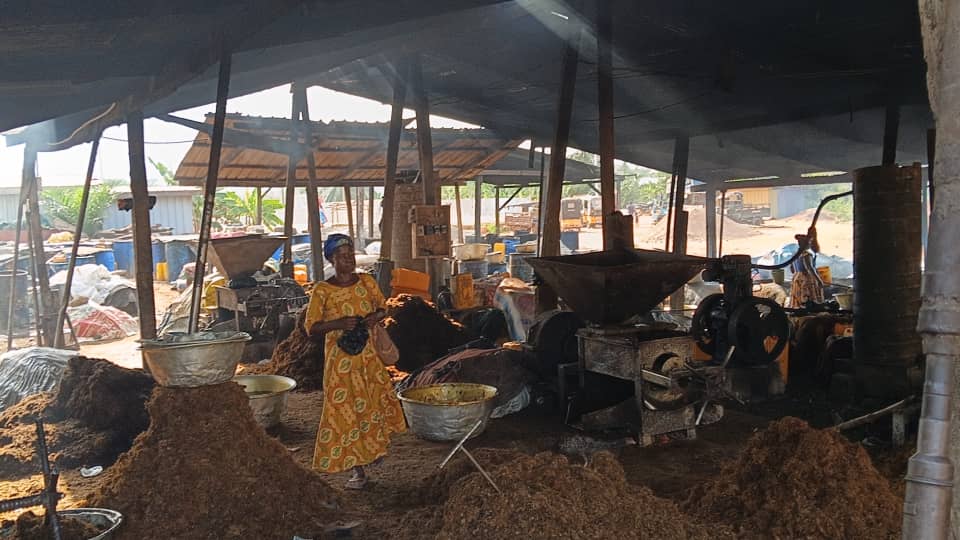
The lack of modern machinery for palm oil production, has left the artisanal industry in the Central Region desperately gasping for breath.
 Producers of the commodity had expressed worry that alongside the attendant life-threatening working conditions, were a raft of economic and social challenges, including lack of capital, theft and the unresolved menace of smuggling, which had left many producers hanging by a thread.
The workers, mostly women said they were forced to use primitive technologies as well as slow, painful, perilous and unhygienic methods, which exposed them to unbearable heat and injuries.
Some of the women said they were walking on a tight rope with their continuous stay by the fire, having developed serious medical conditions from their years of prolonged exposure to the heat.
They have, therefore, appealed to the government to provide the industry with state-of-the-art technologies to improve production, reduce health risks and avert its imminent collapse.
The oil palm processors shared their ordeal when the leadership of the Oil Palm Development Association of Ghana (OPDAG), led by Mr Paul Amaning, the President, embarked on a working tour to some processing sites in the Central Region.
The team visited the Twifo Oil Palm Plantation (TOPP), an industrial processing facility, and Sasah Abban Enterprise, an artisanal processing site at Twifo Praso.
At Sasah Abban Enterprise, dozens of women, who were busily working in their respective “departments” soaked in sweat under hot sheds, shared their frustrations with the team, calling for urgent government support.
Beyond the lack of appropriate technology, the processors expressed concern about the smuggling of palm oil, which they said had virtually pushed them out of the market and contributed to oil gluts.
Consequently, they were forced to sell their products at unreasonably low prices to enable them to settle their debts and threatened to embark on a protest, if decisive actions were not taken to curb the smuggling of palm oil.
Nana Sasah Abban, the founder of Sasah Abban Enterprise, admitted that although their processing facility was not the best, but it was what they could afford.
“We need machines with conveyors to make the work safer and faster because, with such equipment, nobody would have to personally carry hot water for disposal. Those machines are very expensive and so we need the government to come in and support us acquire them.
Touching on smuggling, he said, “customers no longer buy from us even when they curry our products to them at the markets and we are forced to reduce our prices because our creditors are breathing down on our necks.”
Madam Yaayaa, who has been in the business for 24 years, narrated the risks and struggles involved in cultivating, harvesting and transporting the palm fruits to the processing sites.
She said “Working around the fire is tough because it makes us sick all the time. Just a few days ago, one of us suddenly fell ill and nearly died if she had not been rushed early to the hospital.”
She confirmed that buyers were hard to come by and that the few who visited imposed their own prices.
For her, she wanted the government to set prices for palm oil just as it was being done for cocoa farmers to protect both farmers and processors against undue exploitation.
Maame Adwoa, another worker, reiterated the call for investment to expand their business and rescue them from their perilous conditions.
“My doctor has cautioned me to stop this work, but I continue to do it even though it does not pay much because I have no other source of livelihood and have children to cater for,” she said.
For Madam Ruth Asamoah, a major challenge was the lack of storage facilities, which left their palm fruits exposed to the harsh weather condition.
“We don’t have convenient storage facilities to keep our palm fruits and so they are sometimes exposed to the rain and sunshine,” leaving them rot and become unfit for producing edible palm oils, hence they were forced to process the fruits into oil for soap-making rather than for human consumption, leading to incurred losses, she noted.
The concerns and demands of the artisanal processors came at the backdrop of the government’s $500 million fund allocation for the development of the oil palm industry in Ghana.
Mr Amaning, the President of OPDAG, backed the calls of the women processors, saying they played a critical role in the value chain and deserved to be protected.
He suggested that the government’s proposed $500 million investment should be directed towards improving processing facilities, expanding plantations, training, and regulatory enforcement among other critical areas of the value chain.
Specifically, he made a strong case for the modernisation of small- and medium-scale processing mills through grants or loans to upgrade their facilities and improve efficiency.
In furtherance of this, he also called for the establishment of packaging facilities within artisanal palm oil processing mills, emphasising that improved packaging would increase the market value of locally produced oil and reduce the risk of adulteration, thereby protecting consumers.
Beyond that, Mr Amaning stressed the need for investment in improve seedlings and mechanised farming as some farmers still relied on cattle for farming activities.
He said the introduction of machinery would make farm operations, including fertiliser application, easier and more efficient.
The OPDAG President further implored the government to invest in the establishment of 100,000 hectares of oil palm plantations across the country, to increase domestic production and reduce Ghana’s dependence on imported palm oil.
Mr Amaning noted that a hectare could produce approximately three tonnes of crude palm oil and at that yield, 100,000 hectares could produce an estimated 300,000 tonnes annually which could make Ghana self-sufficient in palm oil production.
He impressed upon the government to regulate the volumes of imported vegetable oils in the country to help strengthen the domestic market for local producers and processors.
He described the uncontrolled importation of vegetable oils as a regulatory failure, calling on the government to introduce a traceability and a revenue assurance system, under which every litre of imported oil would be coded.
The system, he indicated, would help to identify the origin and volume of imported products and help government monitor and control imports.
Mr Daniel Kodwo Nyame, the Managing Director of TOPP, the biggest employer in agro-processing in the Central Region, has bemoaned illegal small-scale mining (galamsey) activities in the area, saying it was undermining the oil palm industry.
He said aside polluting water sources, galamsey was depriving the company of skilled workers on its oil palm plantations, who had received training in harvesting, pruning, equipment maintenance and other technical operations.
Consequently, the company currently could only achieve about 50 per cent of its required harvesting capacity, against a target of 80 per cent.
On the market, he corroborated the account of the artisanal processors, observing that the influx of smuggled palm oil was making it difficult for local producers to supply refineries.
He said smuggled products were sold at prices nearly 20 per cent lower than local products, which forced them to offer substantial discounts to attract buyers, underscoring the need for government intervention.
By Prince Acquah, GNA